
Customer experience has become a critical performance indicator for enterprise and government organisations and recent data suggests many are falling short. Forrester's 2024 CX Index recorded a measurable decline in Australian customer experience scores, with the banking sector posting its lowest result since 2020 and the government sector dropping 3.5 points year-on-year.
For senior leaders, this isn't simply a service quality concern. Poor customer experience carries direct financial exposure Australian businesses risk losing up to 7% of revenue as a result of it. In regulated sectors where trust is foundational, the reputational and operational consequences of service failure extend well beyond that figure.
The root cause, in many cases, isn't a lack of intent. It's the constraint of inflexible, generic software that was never engineered to meet the operational complexity of modern enterprise or government service delivery. Tailored software addresses that structural problem.
Why Customer Experience Is a Governance and Operational Priority
The evidence linking system architecture to customer outcomes is consistent. Organisations that achieve meaningful CX improvement retention rate increases of up to 89%, and revenue performance 4-8% above market average do so not through service culture initiatives alone, but through the reliability, integration, and configurability of the systems underpinning every customer interaction.
In healthcare, financial services, insurance, government, and automotive sectors, fragmented data, process bottlenecks, and disconnected platforms are the primary failure points when organisations strive to enhance customer experience. The strategic implication is direct: CX performance is, in large part, a function of architectural control. Organisations that lack it are managing a structural risk not just a service gap.
The Limits of Off-the-Shelf Software
Standard software products are built for the broadest possible market which means they are optimised for no organisation in particular. For enterprise and government bodies managing complex workflows, strict compliance obligations, and diverse stakeholder environments, the gap between what packaged software offers and what operations actually require is rarely bridgeable.
Common structural constraints include:
- Generic functionality that fails to map to specialised processes or regulatory frameworks, making it harder to achieve compliance at the system level.
- Limited scalability that produces bottlenecks as service volumes, user bases, or geographic scope expand.
- Integration failures that fragment data across departments, degrade decision-making, and force costly manual workarounds.
- Restricted configurability that requires organisations to adapt their processes to the software's logic inverting the relationship between technology and governance.
The risk compounds over time. Vendor-controlled update cycles can alter workflow behaviour without organisational input, introducing systemic disruption that procurement governance was never designed to anticipate. In regulated environments, this loss of architectural control is not a minor inconvenience, it is an operational liability.
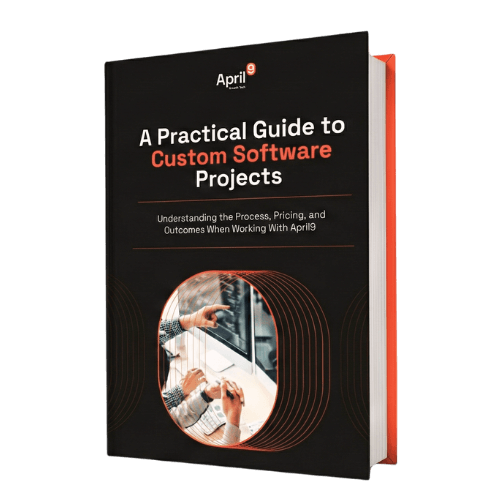
Free Guide
A Practical Guide to Custom Software Projects
Real pricing, transparent processes, and an honest look at what it takes to build software that lasts before you commit to your next project.
Download the Free GuideThe Strategic Case for Tailored Software
Purpose-built software is engineered around the actual requirements of the organisation, its operational processes, compliance environment, integration landscape, and long-term service obligations. The advantages are architectural, not merely functional.
Personalisation at Scale
Tailored software enables organisations to apply their own customer data in service delivery through contextually relevant interactions, predictive support, and dynamic service configuration. In competitive or high-obligation sectors, the ability to act on customer intelligence in real time is a governance capability as much as a commercial one.
Streamlined Operations and Reduced Process Risk
Custom solutions automate high-volume, repetitive processes and reduce the surface area for manual error. In claims processing, case management, and public-facing service delivery, this translates into measurable improvements in resolution time, consistency of outcome, and auditability of process, each of which carries compliance significance in regulated environments.
Integration Across Existing Architecture
Tailored solutions are built to operate within your existing infrastructure, not around it. Connecting CRM platforms, inventory systems, compliance tools, and legacy databases into a unified data environment eliminates the silos that degrade both operational performance and regulatory reporting. This is particularly material for organisations managing multi-system estates inherited through growth or government mandate.
Scalability and Long-Term Maintainability
Enterprise and government requirements evolve through legislation, policy change, organisational growth, and new service mandates. Purpose-built software is designed to accommodate that evolution without requiring full system replacement. Functionality can be extended, reconfigured, or retired at the component level, protecting prior architectural investment and reducing the disruption of forced migrations.
Governed, Actionable Intelligence
Custom analytics capabilities provide leadership with a direct view of operational performance, service outcomes, and risk indicators configured to the metrics that matter in your context. This replaces reliance on vendor-defined reporting structures with intelligence that supports genuine governance and strategic decision-making.
Managing Implementation Risk
The execution risk of tailored software implementation is real and warrants structured governance from the outset.
Successful delivery requires cross-functional commitment that extends well beyond the IT function:
- Define requirements with precision. Compliance obligations, integration dependencies, and operational pain points should be fully mapped before any development brief is issued.
- Select a delivery partner with sector depth. Regulatory requirements and legacy integration complexity demand a partner who has operated in your environment, not one learning it at your expense.
- Treat change management as a delivery risk. Technology implementations fail most often at the adoption stage. Insufficient training, unclear ownership, and misaligned stakeholder expectations are as consequential as technical defects.
- Engage all critical stakeholders at the outset. Procurement, IT, operations, compliance, legal, and supplier representatives all carry implementation risk. Their involvement from the beginning reduces friction at every subsequent stage.
- Architect for change. Future regulatory shifts, service expansions, and organisational restructures should be anticipated in the solution design not retrofitted later.
Case Study: easyauto123 and Eagers Automotive
Eagers Automotive engaged April9 to address operational and customer experience failures across the easyauto123 used car retail operation. Fragmented inventory management and disconnected customer-facing systems were creating measurable inefficiencies and limiting the quality of interactions across the full purchase journey.
April9 delivered a purpose-built platform integrating real-time inventory tracking, unified data pipelines, and a reconfigured customer interface engineered to align with easyauto123's operational model rather than requiring the business to conform to a packaged software's constraints.
The result was a 20% reduction in operational costs within the first year, alongside a materially improved end-to-end purchase experience and significant reduction in process errors. The platform was designed to scale providing Eagers with an architectural foundation capable of supporting ongoing operational change without further system replacement.
Further reading: Software Project Spotlight: easyauto123 Sales Process Transformation and 20% Operational Cost Reduction in Less Than a Year
How April9 Delivers Tailored Software
April9 builds purpose-built software for enterprise and government organisations through Stack9, our composable software platform. Stack9 provides a governed development architecture structured around reusable, auditable components that can be assembled, configured, and maintained with precision. Delivery timelines are reduced by up to 50% without sacrificing the architectural integrity or compliance posture that complex organisations require.
April9 holds ISO 27001 certification. The platform supports IRAP-aligned delivery for government clients and is designed to meet the security and compliance obligations of regulated industries so implementation proceeds on a known and defensible security baseline, not an assumed one.
Tailored Software for Complex Environments
If your organisation is operating with the drag of legacy systems, managing integration risk across a fragmented technology estate, or facing compliance pressure in a regulated sector, the constraint is architectural and it requires an architectural response.
Generic software was not built for your operating environment. April9 works with enterprise and government organisations to deliver custom software that integrate with existing infrastructure, meet regulatory obligations by design, and are engineered to evolve as requirements change without the disruption of repeated platform migrations.
Contact April9 to discuss your organisation's software environment and explore what a tailored solution would mean for your operational performance and compliance posture.