
Most custom software proposals that fail to win approval were not rejected because the idea was wrong. They were rejected because the document presented a technology argument to a financial audience. The CFO reviewing a capital request does not need to understand how the software works. They need to understand what the problem costs today, what the proposed solution costs to build, and what it returns. When those three things are clear and credible, the conversation changes. When they are absent, the proposal stalls.
For IT leaders in Australian organisations, building internal approval for custom software investment is often the hardest part of the project. The path from problem identification to board or executive approval requires a document that speaks the language of risk, return, and governance: not features and functionality. A well-constructed business case is not a specialist skill. It is a structured argument.
Why Most Custom Software Proposals Fail to Win Approval
The Standish Group CHAOS report, which has tracked IT project outcomes for three decades, consistently finds that fewer than one in three IT projects is delivered successfully. One of the top predictors of failure across those studies is the absence of executive support, which is itself a product of a business case that did not make the value visible to decision-makers.
The gap is usually not the quality of the idea. It is the translation between what IT sees and what finance and leadership need. IT leaders tend to frame proposals around capability: what the software will do, what integrations it will enable, what manual processes it will replace. Executives evaluate proposals against capital allocation criteria: what is the cost of doing nothing, what alternatives were considered, what is the expected return, and who is accountable if it goes wrong.
Understanding that gap is the starting point for building a business case that succeeds. The challenge of communicating ROI and IT value to the business is well-documented, and the business case document is where that gap is either bridged or widened.
Start With the Problem, Not the Solution
The most common structural error in software investment proposals is leading with the solution. A document that opens with a description of a proposed platform, its architecture, or its feature set is already losing the audience it needs most.
Every compelling business case opens with a precise description of the current-state problem and, critically, what that problem costs. This is the baseline against which every investment figure will be evaluated. Without it, the cost of the proposed solution has no context. With it, even a significant investment can look straightforward when weighed against the accumulated cost of inaction.
Quantifying the current-state cost requires honest analysis across several categories. Direct labour cost is the most tangible: how many hours per week are staff spending on manual processes that software would automate, and what does that time cost at fully loaded rates? Error and rework cost is the next layer: what does a processing error cost to identify and correct, and how frequently does it occur? Revenue impact is harder to quantify but often the most compelling: are there opportunities the organisation cannot pursue, or customers it cannot serve, because the current system will not support them? Compliance and risk exposure completes the picture: what is the potential cost of a regulatory breach, a data incident, or an audit finding that the current architecture makes more likely?
The sum of these figures is the cost of doing nothing often described as the hidden costs of legacy software and it is usually larger than anyone expected.
The Build vs Buy Question Every Business Case Must Answer
Before any executive approves a custom software investment, they will ask why an off-the-shelf product cannot solve the problem. This question deserves a direct and well-researched answer, because it is a legitimate one. The business case must address it head-on rather than assume the audience will accept custom development as the default.
The honest answer for most organisations is that generic software products solve generic problems. When the requirement involves integrating with existing enterprise systems a vendor does not support, handling achieve compliance obligations specific to the Australian regulatory environment, or managing workflows that diverge significantly from the vendor's standard model, the off-the-shelf option typically involves substantial customisation, integration cost, and ongoing licence obligations that erode the apparent cost advantage.
The comparison should be documented in the business case with specifics: which products were evaluated, what each would require in implementation and customisation cost, what ongoing licence fees would apply, and what functional gaps would remain. A properly documented alternatives analysis makes the custom development investment look considered, not reflexive.
Related Reading: The True Cost of Custom Software Development
Quantifying the ROI of Custom Software
The return on investment calculation for custom software does not need to be precise to be effective. It needs to be credible, conservative, and structured around categories the finance audience recognises.
Three categories of return are most useful. Efficiency gains are the most straightforward to model: identify the manual processes that will be automated or accelerated, estimate the time saving per process per week, apply the fully loaded cost of the staff involved, and project that saving over a three-to-five year horizon. Claiming 60% of the theoretical saving rather than 100% improves credibility without materially weakening the case.
Revenue enablement is the category most often omitted and most often decisive. If the new system enables the organisation to serve a customer segment it currently cannot, or reduce a turnaround time that currently causes attrition, the revenue implication should be estimated even if it requires assumptions. A sensitivity analysis showing the return at conservative, base, and optimistic scenarios is more persuasive than a single number, and it signals that the proposer has thought carefully about what they are claiming.
Risk reduction is the third category and the one most relevant to compliance-intensive organisations. What is the estimated cost of a regulatory breach that the current architecture makes more probable? What would a data incident cost in remediation and reputational terms? Reducing the probability of an event with a quantifiable cost has a calculable value, even if the probability itself is estimated.
Related Reading: How to Accurately Price a Software Development Project
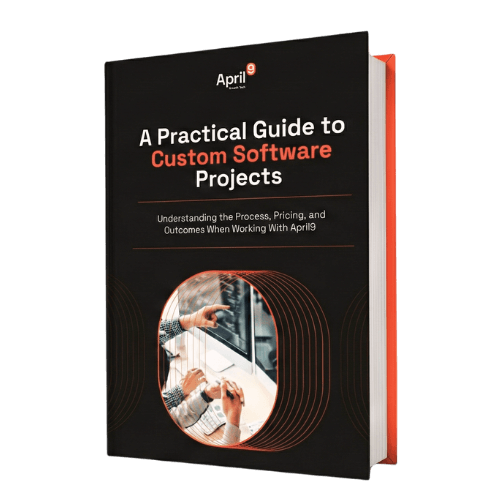
Free Guide
A Practical Guide to Custom Software Projects
Real pricing, transparent processes, and an honest look at what it takes to build software that lasts before you commit to your next project.
Download the Free GuideHow to Frame Risk for a Risk-Averse Audience
Executives who decline to approve software investments are not usually making a bad decision. They are responding rationally to a proposal that has not adequately addressed their risk concerns. The business case that wins approval is the one that makes the risk of proceeding look smaller than the risk of not proceeding.
The risk of inaction deserves as much space in the business case as the risk of the project itself. If the current system creates compliance exposure, that exposure is growing with every regulatory update it cannot accommodate. If the architecture is accumulating technical debt, the cost of the eventual forced replacement is increasing. These are real risks with real cost implications, and they belong in the risk register alongside project delivery risk.
On the project side, the most common reasons IT projects fail include unclear goals, poor communication, and insufficient resources, all of which are mitigated by approach, not avoided by inaction. A business case that proposes a phased delivery model, starting with a scoping phase before significant capital is committed, lowers the perceived risk of the overall investment substantially. Asking for approval of an initial scoping phase is a much smaller ask than requesting approval of a full build, and a well-executed scoping phase produces the artefacts that make the subsequent approval straightforward.
What a Strong Business Case Document Includes
The business case document should be structured so that an executive can read the first page and understand the core argument, then find supporting detail in the sections that follow. The one-page executive summary is not a formality. It is the document that circulates before the meeting and shapes the decision before anyone enters the room.
A complete business case covers the quantified current-state problem, the alternatives considered and why each was rejected, the recommended solution, a full cost model, the ROI calculation, a risk register with mitigations, the governance and accountability model, the implementation timeline, and the credentials of the proposed delivery partner. The partner credentials section is most often left out and should not be. ISO 27001 certification, relevant case studies, and a named delivery methodology address the governance objection before it is raised.
How April9 Supports Custom Software Investment Decisions
April9's custom software development services are structured to reduce the cost and approval risk of exactly the investment decision described above. Work typically begins with requirements gathering and solution design before development investment is committed, producing the architecture and cost documentation an organisation needs to build a credible internal business case.
The Stack9 composable platform directly addresses two of the most common reasons software proposals stall: timeline uncertainty and cost unpredictability. Because Stack9 provides a library of auditable, reusable components built on standardised API interfaces, delivery timelines are reduced by up to 50% compared to fully bespoke development. That reduction in timeline directly improves the cost model in the business case, making the investment figures more defensible.
April9 holds ISO 27001 certification, a credential relevant to any business case that needs to address data security and governance objections, and brings IRAP-aligned delivery experience for engagements where government security standards apply. The organisation's track record across government, insurance, healthcare, and enterprise environments provides the case study evidence a business case partner credentials section requires.
The Business Case Is the First Project Deliverable
A business case for custom software is not administrative overhead that precedes the real work. It is the first deliverable of the project, and its quality determines whether the project happens at all. An organisation that invests in getting this document right is also doing the early thinking that makes the project itself more likely to succeed.
The discipline of building the business case forces the clarity of requirements and outcomes that the Standish Group consistently identifies as the primary predictor of IT project success. The document that wins approval and the thinking that produces a well-scoped project are the same thing. If your organisation is ready to build a compelling case for custom software investment, the April9 team is well placed to help you structure the argument. Get in touch through the April9 to start a conversation.
Further Reading: April9 Custom Software Development Services