

Software maintenance is one of the most significant and least scrutinised items in an enterprise IT budget. For most Australian organisations, the cost of keeping existing systems operational, patched, integrated, and compliant consumes the majority of available IT spend before any investment in new capability is considered. Industry research consistently finds that organisations spend between 60 and 80 percent of their IT budgets on maintaining existing systems rather than building new ones.
The accepted narrative is that maintenance costs are an unavoidable consequence of running enterprise software at scale. This is only partially true. Some maintenance expenditure is genuinely unavoidable: security patching, compliance updates, and performance monitoring are ongoing obligations for any production system. But a significant portion of maintenance cost in most organisations is not unavoidable. It is the predictable consequence of architectural decisions made when the system was built, or decisions that were deferred and subsequently accumulated as technical debt.
The implication is important. Maintenance costs are not primarily an operational problem to be managed. They are an architectural problem to be solved. Organisations that address the architectural conditions that drive maintenance cost will see a materially different cost profile over the lifetime of their systems than those that manage maintenance reactively without addressing its structural causes.
Why Maintenance Costs Keep Rising
For most enterprise software systems, maintenance costs do not stay flat over time. They escalate. Understanding why this happens is the first step toward building systems that break the pattern.
The escalation follows a predictable sequence. A system is delivered under time and budget pressure, with architectural shortcuts taken to meet the delivery deadline. Integration points are built point-to-point rather than through standardised interfaces. Business logic is embedded directly in the application layer rather than abstracted into configurable rules. Documentation is deferred. Testing coverage is incomplete. Each of these decisions reduces delivery time at the cost of increased maintenance overhead.
As the system operates in production, the consequences compound. New integrations require bespoke engineering because the existing integration architecture was not designed for extension. Regulatory changes require manual code updates because the business rules were not externalised. Security patches take longer to apply because the system's components are tightly coupled and changes in one area produce unexpected effects elsewhere. Staff turnover means institutional knowledge about undocumented design decisions is lost, and rework becomes necessary to understand what was built before it can be modified.
This pattern is what drives how legacy systems hold businesses back from investing in new capability. By the time an organisation recognises that maintenance costs have become unsustainable, the architectural conditions driving those costs have typically been accumulating for years. The hidden costs of legacy software are consistently underestimated because they are not measured, not because they are small. The six strategies to trim technical debt covers tactical approaches to reducing this accumulated burden, but the most effective intervention is designing systems that do not accumulate it in the first place.
The Architectural Decisions That Drive Maintenance Cost
Maintenance cost in enterprise software is determined by a small number of architectural decisions that have outsized long-term consequences. Understanding which decisions matter most allows organisations to make informed trade-offs during design rather than discovering the cost implications years later.
The decisions with the highest maintenance cost impact are:
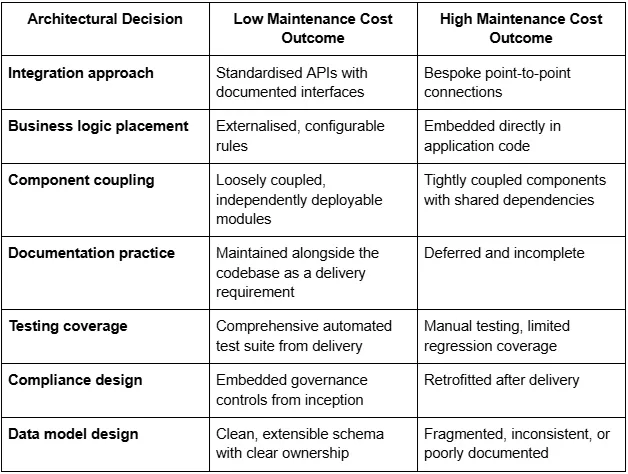
Each row in this table represents a decision made during design and delivery that has a direct impact on the cost of maintaining the system over its operational lifetime. The low maintenance cost outcome in each row requires more discipline and slightly more time during delivery. The high maintenance cost outcome reduces delivery time at the cost of a higher ongoing maintenance burden that compounds over years.
What a Well-Architected System Actually Looks Like
A well-architected system is not one that uses the most sophisticated technology or follows the most current design patterns. It is one that is built to be understood, extended, and maintained by people who were not involved in building it, without requiring heroic effort or access to undocumented institutional knowledge.
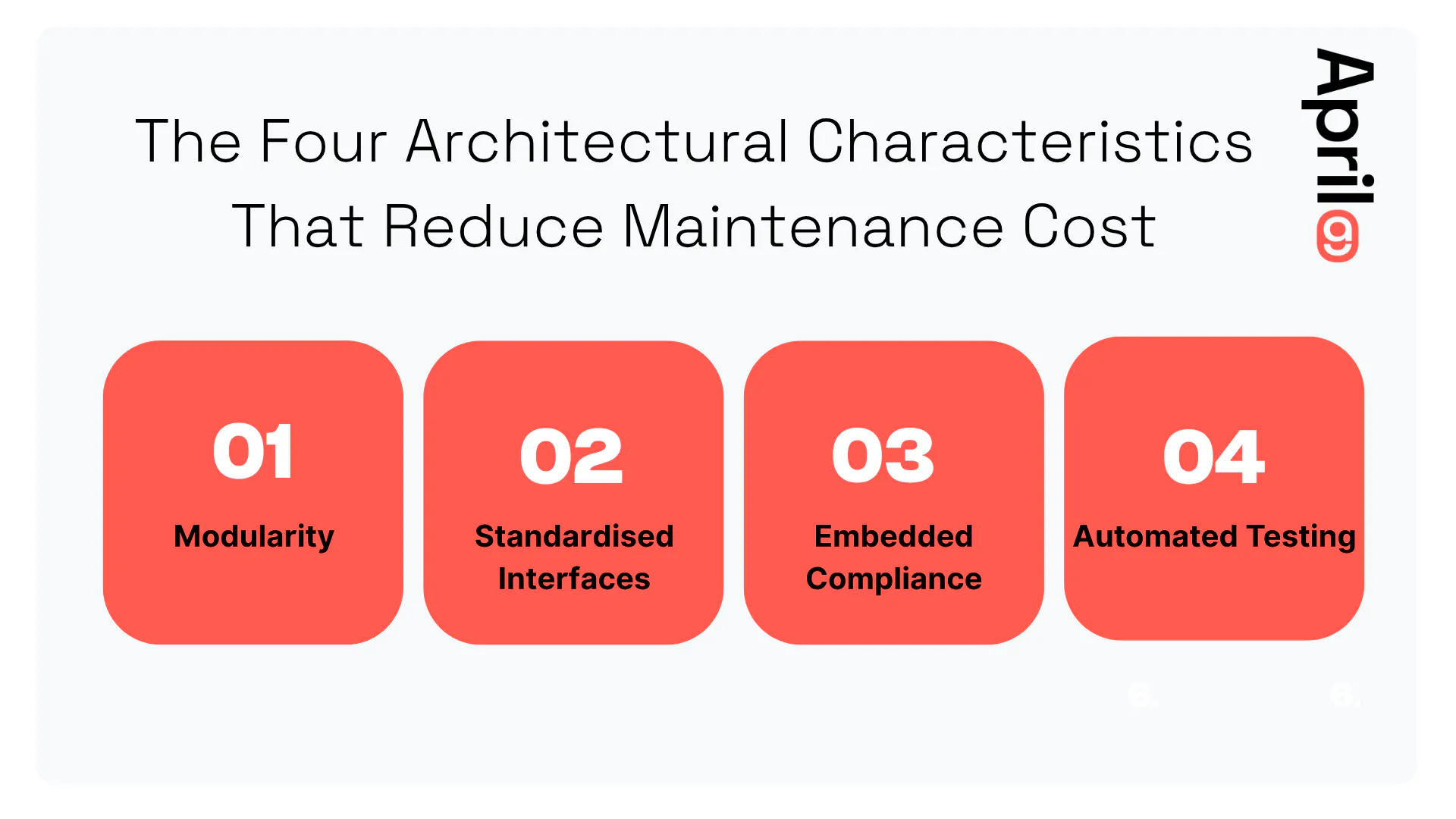
The characteristics that produce this outcome are consistent across different technology stacks and application types:
Modularity. System components are independently deployable and maintainable. A change to one component does not require changes to others. This reduces the risk and effort of updates and allows individual components to be replaced without disrupting the rest of the system.
Documented integration boundaries. Every integration point between the system and external dependencies is documented, versioned, and stable. Changes to connected systems are absorbed at the interface boundary rather than requiring changes throughout the application.
Externalised configuration. Business rules, workflow definitions, and configurable parameters are stored outside the application code and can be updated without a code deployment. This reduces the volume of deployments required to accommodate operational changes and the risk that each deployment introduces.
Automated testing. A comprehensive automated test suite that runs on every code change provides the confidence needed to deploy updates quickly and the safety net needed to catch regressions before they reach production. Systems without adequate test coverage require significantly more manual effort to validate each change.
Embedded compliance controls. Access controls, audit logging, and data handling policies are structural properties of the system rather than operational overlays. They do not need to be retrofitted when compliance requirements change because they were designed to accommodate change from the outset. For Australian organisations operating under ISO 27001 standards or sector-specific regulatory frameworks, embedding these controls from the start eliminates a recurring remediation cost that compounds over the system's lifetime.
These characteristics are the architectural foundation of the composable approach to enterprise software. For a broader view of how composable architecture supports long-term flexibility and cost control at the programme level, the article on architectural discipline and cost control in enterprise software programmes covers the programme-level implications in detail.
Free Playbook
Legacy System Modernisation: A Practical Playbook for IT Decision Makers
Practical frameworks and real-world case studies to help you modernise outdated systems without the usual transformation headaches.
Download the Free PlaybookThe Composable Architecture Advantage
Composable architecture reduces maintenance costs by design rather than by accident. The core principle is that software systems are assembled from pre-built, independently maintainable components rather than built as monolithic applications where every element is tightly coupled to every other.
The maintenance cost advantages of this approach are direct and measurable:
- Reuse reduces rework. Components that have been built, tested, and validated in previous deployments do not need to be rebuilt when similar capability is required in a new context. This reduces both delivery cost and the volume of new code that needs to be maintained.
- Independent deployability reduces deployment risk. When components can be updated independently, the risk of each deployment is contained to the component being changed rather than distributed across the entire system. This reduces the cost and frequency of deployment-related incidents.
- Standardised interfaces reduce integration maintenance. When all components expose standardised interfaces, the cost of connecting new systems or updating existing connections is predictable and contained rather than requiring bespoke engineering for each new integration.
- Pre-tested components reduce defect remediation cost. Components that have been validated across multiple deployments carry lower defect risk than custom-built code, reducing the ongoing cost of bug fixing and security remediation.
April9's Stack9 composable platform is built on these principles. Stack9 reuses 80% of code across projects, which means that the majority of each new system is assembled from components that have already been built, tested, and governed in previous deployments. The maintenance cost profile of a Stack9-delivered system reflects the maturity of those components rather than starting from zero with each new project.
How to Assess Whether Your Current Architecture Is Costing You
For organisations that are already running enterprise systems and want to understand whether their architecture is a significant driver of maintenance cost, a structured assessment covers five dimensions.
1. Integration complexity. How many integration points does the system have, and how many of them are bespoke connections rather than standardised interfaces? Each bespoke connection is a maintenance liability. If the system has a high ratio of bespoke to standardised integrations, integration maintenance is likely a significant cost driver.
2. Change failure rate. What proportion of system changes result in unintended consequences that require remediation? A high change failure rate is a reliable indicator of tight coupling and insufficient test coverage, both of which drive maintenance cost.
3. Compliance remediation frequency. How often does the system require changes to meet compliance obligations, and how disruptive are those changes? Frequent, disruptive compliance remediation indicates that compliance controls were not designed into the system architecture and are being retrofitted repeatedly.
4. Documentation coverage. What proportion of the system's design decisions, integration points, and business logic are documented in a form that is accessible to the current team? Low documentation coverage means that every change requires investigation that would be unnecessary if the system were well-documented.
5. Maintenance cost trajectory. Is the cost of maintaining the system increasing, stable, or declining year on year? A rising trajectory that cannot be explained by increased system complexity or compliance obligation is typically an architectural signal, indicating that debt is accumulating faster than it is being resolved.
If the assessment reveals problems across multiple dimensions, the application modernisation guide provides a clear overview of the modernisation approaches available and when each is appropriate. For situations where the assessment indicates that the system's architecture cannot be addressed incrementally, the decision framework in legacy system replacement versus modernisation provides a structured approach to determining whether the right response is targeted remediation or a more fundamental architectural change.
Reducing Maintenance Cost in Practice
For organisations that have identified architecture as a significant maintenance cost driver, the path to reduction follows a consistent sequence regardless of the specific technology environment.
- Quantify the current maintenance cost accurately. Include direct costs such as support contracts, patch management, and bug fixing, as well as indirect costs such as staff time consumed by manual workarounds, integration failures, and compliance remediation. Most organisations significantly underestimate total maintenance cost because indirect costs are not attributed to the system.
- Identify the highest-cost maintenance drivers. Not all architectural problems contribute equally to maintenance cost. A structured assessment identifies which problems are consuming the most resource and should be addressed first.
- Prioritise integration standardisation. Bespoke integrations are consistently the highest-cost maintenance item in complex enterprise systems. Replacing bespoke connections with standardised API interfaces reduces ongoing maintenance cost and makes the system more resilient to changes in connected platforms. The system integration cost savings available from this change alone often justify the investment independently of other improvements.
- Invest in test automation. Improving automated test coverage reduces the cost and risk of each change, increases deployment confidence, and reduces the time required for regression validation. This is one of the highest-return architectural investments available for systems with low existing test coverage.
- Address compliance design structurally. If compliance controls are being applied as operational overlays rather than architectural features, the recurring cost of compliance remediation will continue regardless of other improvements. Embedding compliance controls into the system architecture eliminates this recurring cost driver. For organisations working to achieve compliance under Australian regulatory frameworks, this investment also reduces the risk of compliance failures between remediation cycles.
- Establish documentation as an ongoing practice. Documentation that is maintained alongside the codebase as a delivery requirement rather than produced as a post-delivery activity provides the context that makes future changes faster and less risky. The cost of maintaining documentation is consistently lower than the cost of the investigation work it prevents.
For organisations evaluating whether custom software development is the right path to address architectural maintenance cost, the investment decision is most defensible when it is grounded in a quantified comparison of current maintenance costs against the projected cost profile of a well-architected replacement, over a five-year horizon that reflects the full operational lifetime of the system.
Architecture Is a Long-Term Financial Decision
Software maintenance cost is not a fixed overhead that organisations have no control over. It is a variable that is substantially determined by architectural decisions made during design and delivery. Organisations that treat architecture as a technical concern rather than a financial one consistently pay more to maintain their systems than organisations that understand the long-term cost implications of architectural choices.
The most effective way to reduce software maintenance costs is to build systems that are designed to be maintained. That means modular components, standardised integrations, externalised configuration, embedded compliance controls, and documentation as a delivery requirement rather than a deferred obligation. These are not aspirational design principles. They are the specific architectural characteristics that produce measurably lower maintenance costs over the lifetime of a system.
For Australian organisations looking to understand the maintenance cost profile of their current systems and identify the architectural changes that would produce the greatest reduction, April9 brings the technical depth and delivery experience to support that assessment and the implementation that follows. Get in touch to start the conversation.