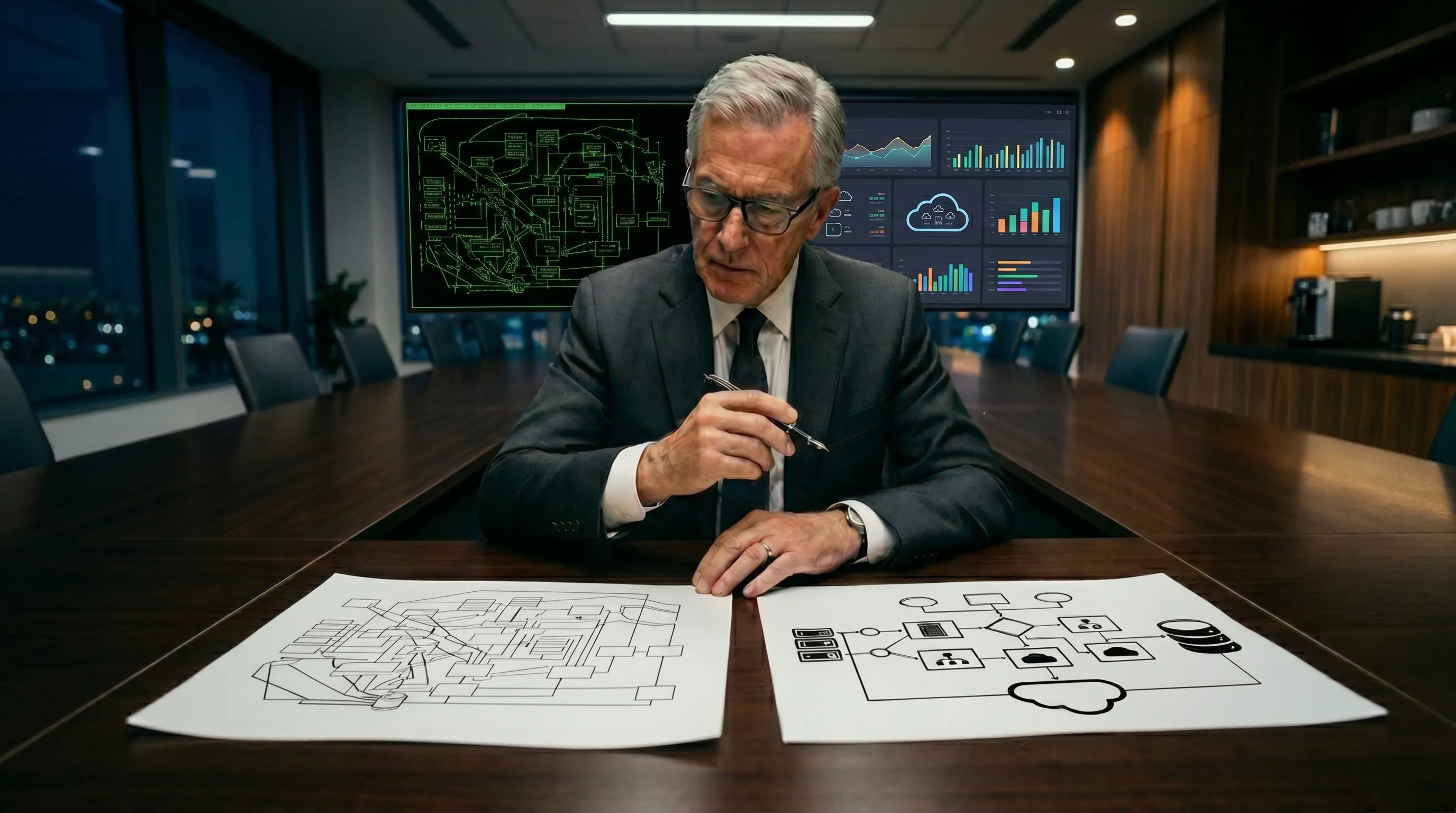
For most Australian IT leaders, the decision to replace or modernise a legacy system is one of the most consequential technology investments they will oversee. The stakes are high on both sides. Replace too aggressively and the organisation absorbs unnecessary cost, disruption, and implementation risk. Modernise when replacement was warranted and the same problems resurface twelve months later, compounded by the investment already spent.
The difficulty is that both options are usually defensible on paper. Modernisation appears less risky and less expensive in the short term. Replacement appears more strategic and more future-proof over the long term. The problem is that neither of these generalisations is reliably true. The right answer depends on a structured assessment of the specific system, the specific business context, and the specific constraints the organisation is operating under.
This article provides a decision framework that Australian IT leaders can apply to make that assessment systematically, understand which modernisation strategies are available and when each applies, and build a business case that reflects the full cost and risk profile of each path.
Why This Decision Is Harder Than It Looks
The replace versus modernise question appears straightforward until the assessment begins. At that point, several complicating factors typically emerge simultaneously.
The first is that the full cost of the status quo is rarely visible. Organisations that have lived with a legacy system for years have normalised the workarounds, the manual processes, the integration patches, and the staff time consumed by system limitations. These costs do not appear as a single line in the IT budget. They are distributed across teams, absorbed into operational overhead, and rarely attributed to the system that is causing them. The hidden costs of legacy software are consistently underestimated because they are not measured, not because they are small. For a broader view of how legacy systems affect organisational performance beyond direct costs, how legacy systems are holding your business back covers the structural impact in detail.
The second complicating factor is that the business case for change is often built around the cost of the intervention rather than the cost of inaction. A replacement project with a significant budget looks expensive until it is compared against five years of escalating maintenance costs, security remediation, integration workarounds, and lost productivity. Framing the decision correctly requires both sides of that equation to be visible.
The third factor is organisational risk tolerance. Replacement carries implementation risk. Modernisation carries the risk of insufficient change. Neither path is risk-free, and the organisation's capacity to absorb disruption during implementation is a legitimate constraint that needs to be built into the framework.
Understanding the Real Difference Between Modernisation and Replacement
Before the framework can be applied, the distinction between modernisation and replacement needs to be precise. These terms are used loosely in practice, which creates confusion when the decision is being debated.
Modernisation involves changing how the existing system is deployed, structured, or extended, while retaining its core logic and data. It preserves what the system does while improving how it does it. Modernisation options range from minor, such as migrating to cloud infrastructure, to significant, such as refactoring the application architecture, but in all cases the existing system is the starting point.
Replacement involves retiring the existing system and implementing a new one. The new system may be an off-the-shelf product, a custom-built application, or a composable platform that assembles capability from pre-built components. In all cases, the existing system's logic and data need to be migrated or rebuilt.
The distinction matters because the two paths have fundamentally different risk profiles, cost structures, and timelines. Modernisation is typically lower risk and faster to implement but may not resolve structural limitations in the system's core architecture. Replacement is higher risk and longer to implement but can address problems that modernisation cannot. For organisations that have already assessed that some form of change is necessary, the guide to modernise or replace legacy software provides useful context on how each approach works in practice before the framework below is applied.
The Four Factors That Drive the Decision
The decision between replacement and modernisation is driven by four factors that need to be assessed honestly before a recommendation is formed.
1. Architectural integrity The most important question in the assessment is whether the existing system's core architecture is sound. A system with poor architecture, tightly coupled components, no separation of concerns, and no integration capability will not be fixed by modernisation. Refactoring can improve performance and extend lifespan, but it cannot change the fundamental design of a system that was not built to scale or integrate. If the architecture is the problem, modernisation is treating the symptom rather than the cause.
2. Total cost of ownership over five years The comparison needs to be made over a meaningful time horizon, not just the immediate project cost. A five-year total cost of ownership analysis for each path should include current maintenance costs, projected maintenance cost trajectory, implementation cost, migration cost, integration cost, and the cost of ongoing support for the chosen solution. Organisations that identify and eliminate zombie SaaS as part of this exercise often find that the rationalisation of unused or redundant tools changes the cost equation significantly.
3. Strategic alignment The system needs to be assessed against where the business is going, not where it is today. A system that adequately serves current requirements but cannot support the organisation's three-year growth plan, regulatory obligations, or technology strategy is a modernisation candidate at best and a replacement candidate at worst, depending on how large that gap is and whether modernisation can close it. For Australian organisations with compliance obligations, the ability of the existing system to support achieving compliance requirements is a critical part of this assessment.
4. Risk profile of each path Both paths carry risk. The risk of replacement includes implementation complexity, data migration integrity, user adoption, and business continuity during transition. The risk of modernisation includes insufficient change, deferred problems, and continued accumulation of technical debt if the underlying architecture is not addressed. The assessment needs to quantify both risk profiles rather than defaulting to the assumption that modernisation is inherently safer.
Free Playbook
Legacy System Modernisation: A Practical Playbook for IT Decision Makers
Practical frameworks and real-world case studies to help you modernise outdated systems without the usual transformation headaches.
Download the Free PlaybookA Practical Decision Framework
The following framework structures the assessment into a sequence of questions that progressively narrow the decision space. It is designed to be applied to a specific system in a specific organisational context, not as a generic checklist.
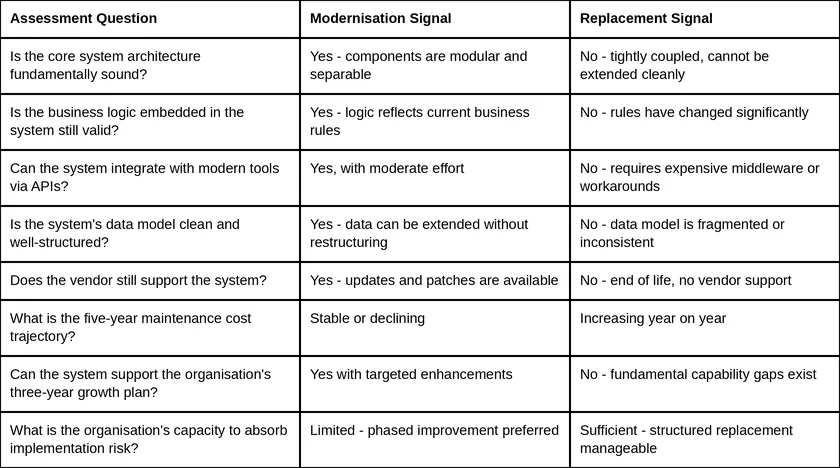
A pattern of modernisation signals across most categories indicates that targeted investment in the existing system is the right path. A pattern of replacement signals, particularly across architecture, vendor support, and strategic alignment, indicates that modernisation will not resolve the underlying problems and replacement should be planned.
The Modernisation Strategies Available and When Each Applies
If the assessment indicates modernisation, the next decision is which modernisation approach is appropriate. The four main strategies each carry different cost, complexity, and outcome profiles.
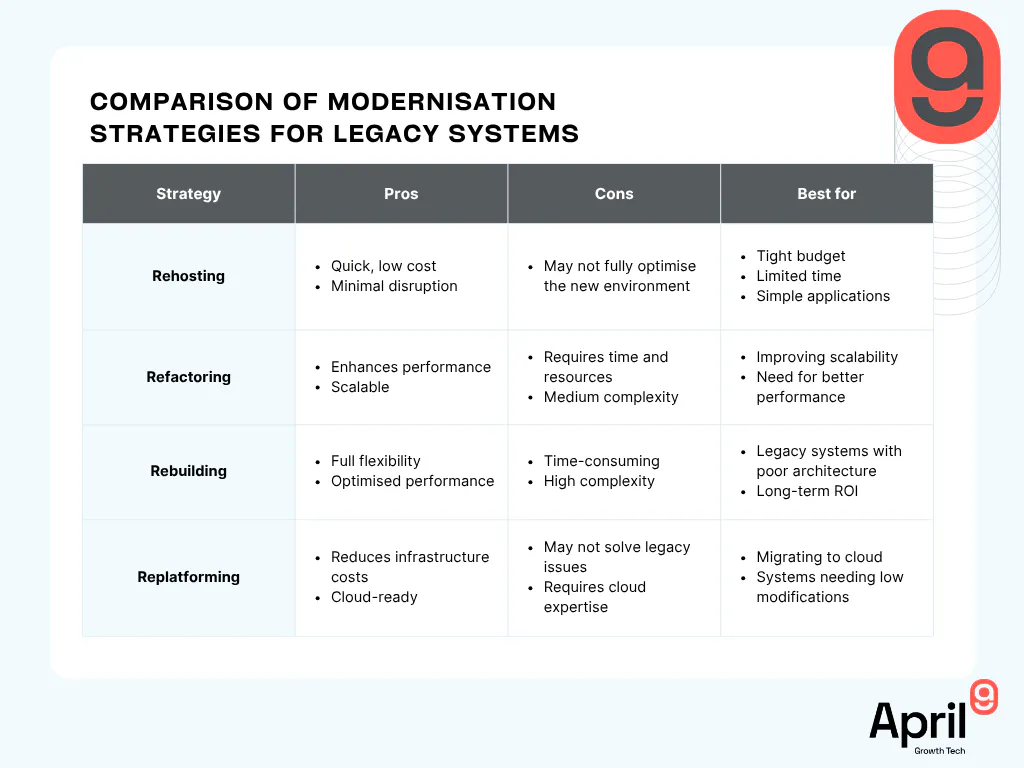
Rehosting moves the application to a new infrastructure environment, typically cloud, without changing the application code. It is the fastest and least expensive modernisation approach and is appropriate when the primary driver is infrastructure cost or availability rather than application capability. It does not resolve application-level problems and should not be used when performance, integration, or security issues originate in the application itself.
Replatforming makes targeted adjustments to the application to take advantage of a new platform environment without changing the core application logic. It reduces infrastructure management overhead and improves scalability without the full cost of refactoring or rebuilding.
Refactoring restructures the application code to improve performance, modularity, and maintainability without changing external behaviour. It is appropriate when the application's business logic is sound but the code structure is creating maintenance overhead or preventing integration. It requires significant development investment and is most justified when the system has a long remaining useful life.
Rebuilding replaces the application with a new implementation that replicates or improves on the existing functionality. It is effectively replacement within the modernisation category and is appropriate when the existing system's logic is valid but the implementation is no longer fit for purpose. The brownfield versus greenfield development decision applies within this option: whether to build on the existing codebase or start from a clean architecture.
What the Decision Looks Like in Practice
The theoretical framework is most useful when grounded in the kinds of situations Australian organisations actually face. Two patterns appear most frequently in practice.
The first is a system that is functionally adequate but architecturally constrained. The business logic is sound, the data is valuable, but the system cannot integrate with modern tools, cannot scale to meet growing demand, and is consuming disproportionate maintenance resource. In this situation, replatforming or refactoring is usually the right approach. The EasyAuto123 engagement is a relevant reference point: a targeted modernisation of legacy systems that reduced marketing costs per unit by 20% within a year, achieved by improving system capability and integration without a full replacement.
The second pattern is a system that has reached end of life in multiple dimensions simultaneously: no vendor support, poor architecture, incompatible data model, and a strategic gap that modernisation cannot close. In this situation, replacement is the correct decision regardless of the short-term cost, because the cost of continued modernisation investment in a system that cannot be made fit for purpose will exceed the cost of replacement within a predictable timeframe. The 5 clear signs you need to modernise your legacy systems article covers the early indicators that typically precede this situation.
How to Structure the Business Case
Regardless of which path the framework points to, the investment decision requires a business case that is credible to finance and executive leadership, not just to the IT function. The most common reason legacy system decisions are deferred is not that the technical case is unclear. It is that the business case has not been constructed in terms that non-technical decision-makers can evaluate.
A credible business case for either path covers five elements:
- Current state cost - the full cost of the existing system including maintenance, support, integration overhead, manual workarounds, and productivity loss attributable to system limitations
- Future state cost - the implementation cost, transition cost, and ongoing support cost of the proposed path over a five-year horizon
- Risk-adjusted comparison - the probability-weighted cost of the risks associated with each path, including the risk of inaction
- Strategic value - the capability the organisation gains and the strategic options that open up as a result of the investment
- Measurement framework - the metrics that will be used to assess whether the investment has delivered what was intended
For Australian IT leaders working to communicate the ROI of IT investment to business leadership, the business case structure is as important as the underlying analysis. A technically sound recommendation that cannot be translated into business terms will not receive the investment it warrants.
Once the decision is made and the path is confirmed, the legacy software migration guide provides a step-by-step implementation framework covering system audit, migration strategy selection, data integrity planning, phased deployment, and post-migration performance monitoring.
Making the Decision With Confidence
The replace versus modernise decision does not need to be made under uncertainty. A structured assessment of architectural integrity, total cost of ownership, strategic alignment, and risk profile produces a defensible recommendation that can be supported with evidence rather than argued from instinct.
What the framework does not resolve is the organisational dynamics that often complicate these decisions: the attachment to familiar systems, the political difficulty of admitting that a previous investment has reached end of life, and the risk aversion that defaults to incremental change when more significant action is warranted. These are real constraints, and a credible framework helps navigate them by grounding the conversation in measurable criteria rather than competing preferences.
April9's Stack9 composable platform is designed to reduce the implementation risk of the replacement path by providing pre-built, auditable components for the capabilities that appear most commonly in legacy replacement programmes. Stack9 reuses 80% of code across projects, reducing development time by up to 50%, which changes the cost and risk profile of replacement in a way that makes it more accessible for organisations that have previously deferred the decision on cost grounds.
For Australian organisations ready to conduct a structured assessment of their legacy systems and determine the right path forward, April9 brings the technical depth and delivery experience to support that process. Get in touch to start the conversation.