
One of the most common frustrations Australian business stakeholders experience with custom software projects is the gap between what they expected and what actually happened. Not in terms of the end product, but in terms of how long the journey took, what was required of them along the way, and when the various decisions and milestones occurred.
This gap is rarely the result of poor delivery. It is almost always the result of inadequate expectations set before the project began. Business stakeholders who understand what a custom software project actually involves, phase by phase, are better prepared to contribute what is needed when it is needed, make decisions at the right points, and maintain confidence in the process even when it feels slower than expected.
This article provides a clear, phase-by-phase breakdown of a custom software project from initial engagement to post-launch support. Timelines are indicative and will vary based on project complexity, integration requirements, team availability, and compliance obligations. The purpose is to give business stakeholders a realistic mental model of the journey so that when they begin one, they know where they are and what comes next.
Why Timelines Are Hard to Predict Without the Right Process
Custom software projects are not like purchasing a product with a known specification. They involve turning a business problem into a technical solution, which requires a period of structured investigation before any build work can be scoped accurately. Organisations that skip this investigation and ask for a fixed price on day one are not getting certainty. They are getting a guess that will either be padded significantly to cover unknown risk or revised when that risk materialises.
The organisations that experience the smoothest project timelines are those that invest in a software discovery phase before committing to a build. Discovery produces the scope certainty that makes everything downstream more predictable: the cost estimate is grounded in understood requirements, the architecture is designed before development begins, and integration complexity is mapped before it becomes a delivery surprise.
Without discovery, timeline estimates are based on assumptions. With discovery, they are based on evidence. The difference between the two is the primary driver of whether a project delivers on time or not. For organisations evaluating how to engage a custom software development partner, understanding this distinction before the first conversation is one of the most valuable pieces of preparation available.
Phase 1: Discovery and Requirements (Weeks 1 to 4)
The first phase of a custom software project is not writing code. It is understanding the problem clearly enough that the right solution can be designed.
Discovery typically runs for two to four weeks depending on project complexity, the number of stakeholders involved, and the integration landscape. During this phase the project team conducts structured workshops with business stakeholders to document requirements, maps the systems the new software needs to connect with, identifies compliance and security obligations, surfaces risks that need to be managed during build, and produces the scope documentation that everything downstream depends on.
What business stakeholders should expect to contribute during discovery:
- Availability for workshops and requirements sessions, typically two to four sessions of two to three hours each
- Access to relevant internal documentation, existing system specifications, and current process maps
- Decision-making authority or access to the person who holds it, particularly for scope and prioritisation decisions
- Timely review and sign-off on requirements documentation before design begins
The deliverable at the end of discovery is a requirements specification, solution architecture, integration map, and a cost and timeline estimate that can be committed to with confidence. This is the document that makes board-level approval possible and sets the baseline against which project performance is measured.
Phase 2: Architecture and Solution Design (Weeks 3 to 6)
Architecture and solution design often overlaps with the latter part of discovery, particularly for more complex projects. This phase translates the requirements into a technical blueprint: the system architecture, the data model, the integration design, the security architecture, and the user experience framework.
For projects using April9's Stack9 composable platform, this phase involves selecting and configuring the pre-built components that will form the foundation of the solution alongside the custom elements that need to be built specifically for the engagement. Because Stack9 reuses 80% of code across projects, the architecture phase is substantially more efficient than in a fully bespoke build: candidate components can be evaluated and selected rather than designed from scratch.
What business stakeholders should expect during this phase:
- Review of wireframes or prototype screens showing the user interface approach
- Input on workflow design and user experience priorities
- Sign-off on the architecture and design documentation before development begins
This phase is the last practical opportunity to make significant changes to scope without impacting build timeline and cost. Changes made during design cost a fraction of the same changes made during development.
Phase 3: Development and Iteration (Weeks 6 to 20+)
Development is where the solution is built. In an Agile delivery model, development proceeds in structured iterations called sprints, each typically two weeks in length. Each sprint delivers a defined set of features or functionality that stakeholders can review, test, and provide feedback on before the next sprint begins.
This iterative approach is what distinguishes modern software delivery from the older waterfall model, where the entire system was built before anyone outside the development team saw it. Iterative delivery surfaces misalignments early, when they are cheap to correct, rather than late, when they are expensive.

Free Guide
A Practical Guide to Custom Software Projects
Real pricing, transparent processes, and an honest look at what it takes to build software that lasts before you commit to your next project.
Download the Free GuideWhat business stakeholders should expect during development:
- Sprint review sessions at the end of each two-week sprint, typically one to two hours, where the development team demonstrates completed features and stakeholders provide feedback
- Timely decisions on any questions or clarifications that arise during development. Delays in stakeholder decisions are one of the most consistent causes of sprint delays
- Review and feedback on features as they are completed, rather than waiting until the end of the project
Development duration varies significantly based on scope. A focused project with a well-defined scope might complete development in six to ten weeks. A complex enterprise system with multiple integration points, compliance requirements, and a broad feature set may require sixteen to twenty weeks or more. The scope defined during discovery is the primary determinant of development duration.
For context on how scope decisions affect project cost and timeline,how to accurately price a software development project covers the relationship between scope, complexity, and cost in detail.
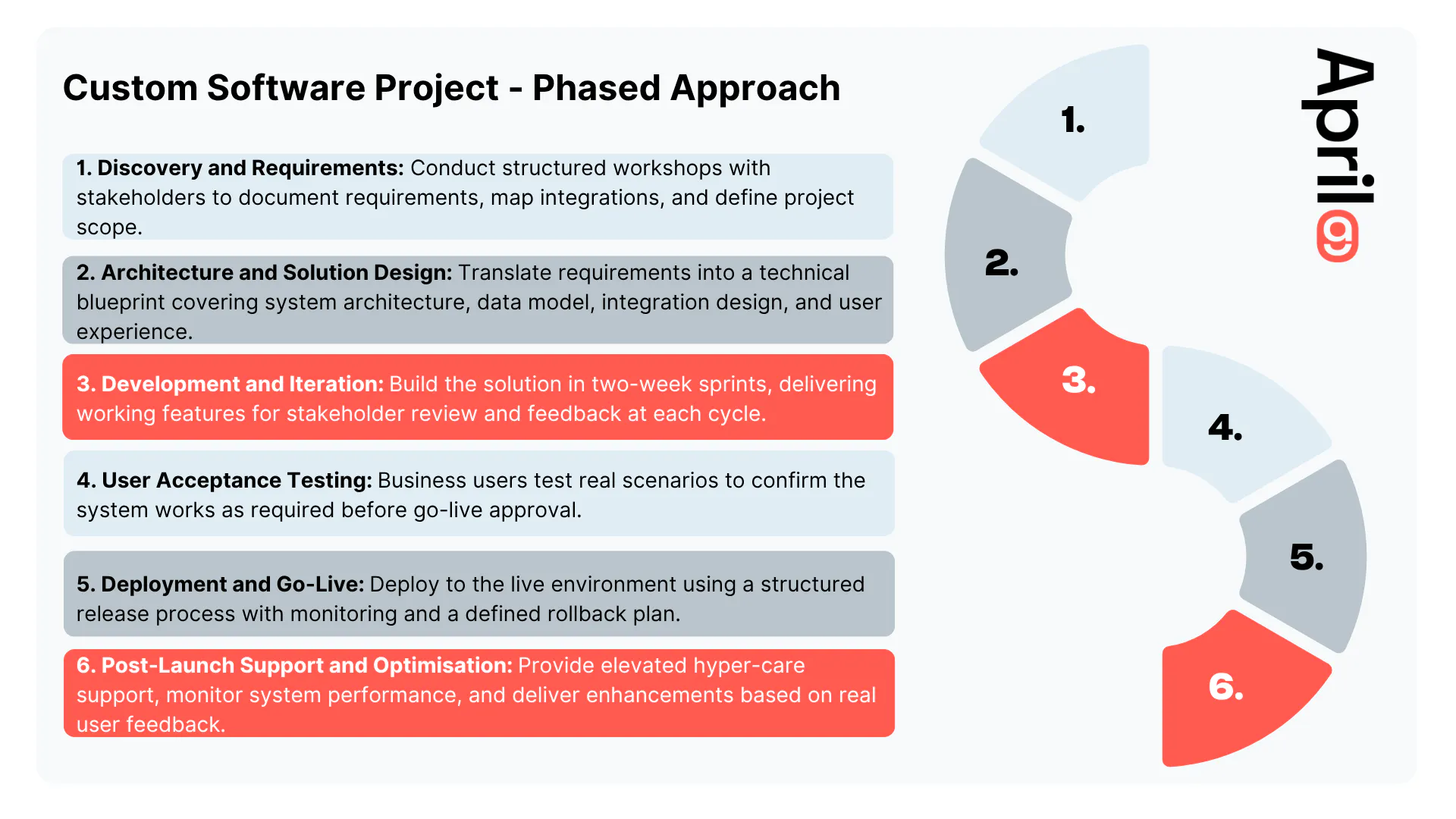
Phase 4: User Acceptance Testing (Weeks 18 to 24)
User acceptance testing, or UAT, is the structured process by which the business confirms that the system works as required before it goes live. It is not a technical test. It is a business test: real users working through real scenarios to confirm that the system does what it was built to do and that the business is ready to operate with it.
UAT typically runs for two to four weeks. The duration depends on the breadth of functionality being tested, the number of user groups involved, and how many issues are identified and need to be resolved before sign-off.
What business stakeholders should expect during UAT:
- Active participation from the users who will operate the system day-to-day, not just the project sponsor
- Time allocated for testing: UAT cannot be done adequately in the margins of a full working day. Plan for meaningful testing time per user per week
- A structured process for logging, prioritising, and resolving issues identified during testing
- A clear acceptance criteria definition: what standard does the system need to meet before go-live is approved
UAT is where the business formally takes ownership of the system. Issues identified during UAT are the last opportunity to resolve problems before they affect live operations. A UAT phase that is rushed or under-resourced is one of the most consistent causes of post-launch incidents.
For organisations working to achieve compliance under Australian regulatory frameworks, UAT should also include validation that compliance controls are functioning correctly: access controls are enforcing the right permissions, audit logging is capturing the required events, and data handling is meeting the applicable obligations.
Phase 5: Deployment and Go-Live (Weeks 22 to 26)
Deployment is the process of moving the tested, approved system from the development and testing environment into the live production environment where real users will access it. A well-managed deployment is not a single event. It is a structured release process that includes pre-deployment verification, a defined cutover sequence, go-live monitoring, and a rollback plan in the event that a critical issue is identified immediately after launch.
For most projects, go-live is preceded by a period of parallel operation where the new system runs alongside the existing one, allowing the business to validate that the new system produces correct outputs before the old one is decommissioned. This is particularly important for systems that handle financial transactions, compliance records, or operational processes where errors carry significant consequence.
What business stakeholders should expect during deployment:
- Clear communication to all affected staff about what is changing, when, and what they need to do differently
- Availability of first-line support for users during the immediate post-launch period, when questions and adjustment needs are highest
- A defined escalation path for any issues identified immediately after go-live
- A monitoring plan covering the first two to four weeks of live operation
April9's approach to deployment follows the six phases of secure software deployment recommended by the Australian Cyber Security Centre and CISA, including canary testing, controlled rollout, and continuous feedback loops throughout the release process.
Phase 6: Post-Launch Support and Optimisation (Ongoing)
A custom software project does not end at go-live. The weeks following launch are among the most information-rich of the entire project: real users interacting with the system in real operational conditions surface usage patterns, edge cases, and improvement opportunities that were not visible during development or testing.
Post-launch support covers two distinct activities. The first is reactive support: identifying and resolving issues that emerge in live operation, including bugs, performance issues, and edge cases that were not anticipated during testing. The second is proactive optimisation: using usage data and user feedback to identify enhancements that improve the system's operational fit.
For organisations that want to continue evolving the system after launch, an ongoing development relationship with the delivery partner is the most efficient model. April9's service offerings support this through structured development cycles that allow the organisation to prioritise and deliver enhancements incrementally rather than commissioning a new project for each change.
What business stakeholders should expect after go-live:
- A hyper-care period of two to four weeks where the delivery team provides elevated support as the system beds in
- Regular reporting on system performance, usage, and any issues identified post-launch
- A defined process for submitting, prioritising, and scheduling enhancement requests
- Clarity on what is covered under the initial project warranty versus what requires a separate support or enhancement engagement
What Causes Timelines to Blow Out
Understanding the factors that most consistently extend project timelines helps business stakeholders recognise and address them before they become delivery problems. Many of the root causes of delay are not technical. They are organisational, and understanding why IT projects fail at a structural level is as important for business stakeholders as it is for delivery teams.
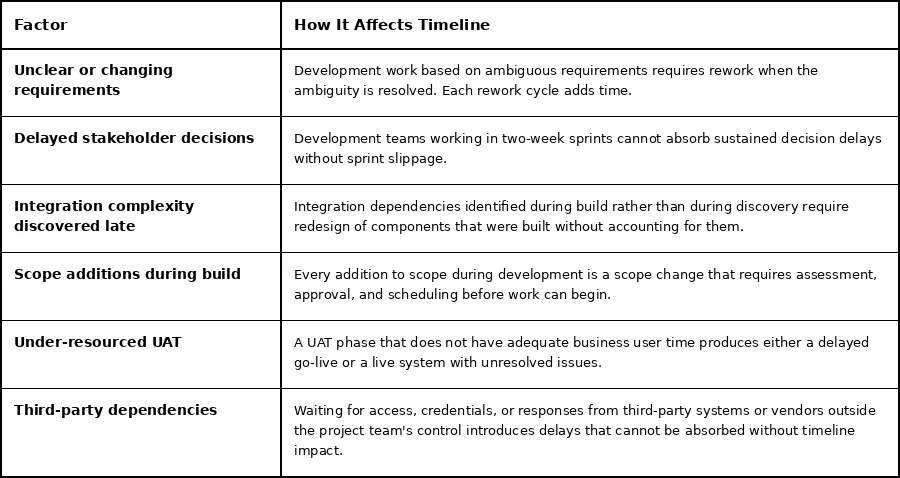
Addressing these factors requires both a disciplined delivery process and engaged business stakeholders. Neither party can prevent timeline blowout alone. The article on how to prevent expensive app development delays covers the strategies that keep projects moving at pace from both the delivery and stakeholder sides.
How April9 Keeps Projects on Track
April9 delivers custom software projects using an Agile methodology with two-week sprints, structured sprint ceremonies, and transparent progress reporting throughout the engagement. The 3-5-3 structure of Scrum that underpins this approach gives business stakeholders regular visibility into what has been built, what is planned next, and what decisions are needed from the business to keep the sprint on track.
The Stack9 composable platform accelerates development by providing pre-built, auditable components for the capabilities that appear most commonly across projects. Because 80% of the solution is assembled from components that have already been built, tested, and governed in previous engagements, development time is substantially shorter than a fully bespoke approach, and the risk of defects in foundation components is significantly lower. Stack9 reduces development time by up to 50% compared to fully bespoke development, which has a direct impact on the timeline that business stakeholders experience.
April9's ISO 27001 certification and IRAP-aligned delivery experience mean that compliance and security requirements are addressed as design inputs from the discovery phase rather than compliance checks applied at the end of the project, which is a consistent source of late-stage delay in projects where these obligations are not addressed from the outset. The Gallagher Bassett and Comcover FNOL engagement is a strong example of this approach in practice: a complex government compliance project delivered within a year, achieving IRAP certification, 30% faster claims processing, and zero security breaches through a structured phased delivery process.
Setting Realistic Expectations From the Start
The most important thing a business stakeholder can do before a custom software project begins is understand what a good project actually looks like: not smooth and effortless, but structured and predictable, with clear phases, defined decision points, and active participation required from the business throughout.
Custom software projects involve genuine complexity. The best delivery partners manage that complexity transparently, surface risks early, and keep the business informed and engaged at every stage. The best business stakeholders come prepared: they know their requirements, they make decisions promptly, they resource UAT adequately, and they engage seriously with sprint reviews rather than treating them as a formality.
When both sides of the relationship operate at that level, the timeline this article describes is achievable. When either side does not, it is not. For a deeper view of what separates a strong delivery partner from a poor one before signing, the guide on how to choose a software development partner covers the ten questions every Australian organisation should ask before committing to an engagement.
For Australian organisations ready to begin a custom software project with clear expectations and a delivery partner who will manage the process professionally from discovery through to post-launch support, April9 is well placed to help. Get in touch to start the conversation.