
When Australian business leaders commission a software project for the first time, one of the earliest questions they encounter is about methodology. The development partner asks whether the organisation wants an Agile or Waterfall approach, often without fully explaining what each means or why the choice matters. The business leader agrees to whichever sounds more modern, or defers to the vendor's preference, without understanding the implications for how the project will run, how the business will need to participate, and what the risks of each approach are in their specific context.
This is a significant gap. The methodology chosen for a software project determines how work is planned and sequenced, how requirements are handled if they change, how progress is measured and reported, how risks surface and are managed, and what the business stakeholder's role is throughout the engagement. Getting this wrong does not just affect how the project runs. It affects whether it succeeds.
This article explains both methodologies clearly, compares them on the dimensions that matter most for business decision-makers, and provides a framework for choosing the right approach for a specific project context.
What Waterfall Development Actually Is
Waterfall is a sequential development methodology in which each phase of the project is completed before the next begins. The typical sequence is requirements, design, development, testing, and deployment. Each phase produces a defined output that becomes the input for the next. Work does not move forward until the current phase is formally completed and signed off.
The name comes from the visual representation of this process: like a waterfall, work flows in one direction and does not flow back. Requirements are defined at the start and locked. Design is completed before development begins. Testing happens after development is complete. Changes to requirements that arise during development require a formal change request process that typically affects timeline and cost.
Waterfall was the dominant methodology for software development for decades, and it remains appropriate for certain types of projects. It works well when requirements are fully known and stable at the outset, when the solution is well-understood before build begins, when regulatory or contractual obligations require a complete specification and formal sign-off at each phase, and when the project team is geographically dispersed or working across organisational boundaries where the overhead of continuous communication would be impractical.
The limitation that matters most for business stakeholders is this: in a Waterfall project, the business does not see working software until late in the process, often after months of development. If the requirements captured at the start did not accurately reflect what the business actually needed, the cost of discovering that late is very high.
What Agile Development Actually Is
Agile is an iterative development methodology in which the project is delivered in short cycles called sprints, typically two weeks in length. Each sprint produces working software that stakeholders can review, test, and provide feedback on before the next sprint begins. Requirements are refined continuously throughout the project based on what is learned as the system takes shape.
Rather than attempting to define everything perfectly at the start, Agile accepts that requirements evolve as understanding deepens, and structures the delivery process to accommodate that evolution without disrupting the entire project. The scope of each sprint is fixed, which maintains delivery rhythm, while the overall product backlog can be updated between sprints to reflect new understanding or changing priorities.
The Scrum framework is the most widely used implementation of Agile in software development. It structures the process around three roles, five events, and three artefacts. April9's Scrum methodology uses two-week sprints with sprint planning, daily standups, sprint reviews, and retrospectives as the core ceremonies that keep delivery on track and stakeholders informed.
The limitation that matters most for business stakeholders is this: Agile requires active, ongoing participation from the business throughout the project. Sprint reviews need to be attended. Decisions need to be made promptly. Feedback needs to be provided within the sprint cycle so it can inform the next one. An Agile project with disengaged business stakeholders will drift, because the continuous refinement process that makes Agile effective depends on the business being present and responsive.
The Core Differences That Matter for Business Stakeholders
The academic distinction between Agile and Waterfall is less important for business decision-makers than the practical differences in how each approach affects the project experience and outcomes.
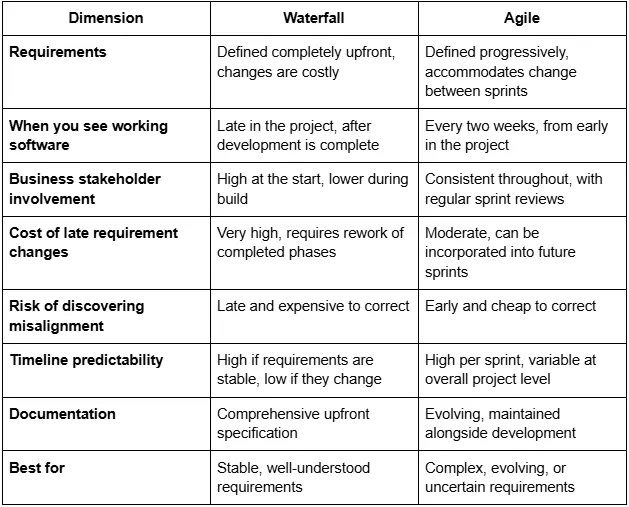
The dimension that most consistently surprises business stakeholders who have not worked on software projects before is when they see working software. In a Waterfall project, the answer may be six months or more into an engagement. In an Agile project, the answer is within the first two to four weeks. This difference has a significant impact on the organisation's ability to identify and correct misalignments before they become expensive.

Free Guide
A Practical Guide to Custom Software Projects
Real pricing, transparent processes, and an honest look at what it takes to build software that lasts before you commit to your next project.
Download the Free GuideWhen Waterfall Is the Right Choice
Waterfall is not obsolete. There are project contexts where its characteristics are genuinely advantageous, and choosing Agile in those contexts would introduce unnecessary risk.
Waterfall suits a project well when:
- Requirements are fully known and stable. Projects that are implementing a well-understood system with no significant uncertainty in what needs to be built benefit from the upfront specification discipline that Waterfall enforces. Regulatory reporting systems with prescribed output formats, for example, often fit this profile.
- Regulatory compliance requires complete documentation. Some government and financial services projects require a formal specification, design review, and sign-off at each phase before proceeding. Waterfall's phase-gate structure accommodates this more naturally than Agile's iterative approach.
- Fixed price, fixed scope contracts are required. Organisations that must commit to a fixed price and a fixed deliverable before work begins are effectively committing to a Waterfall-compatible scope definition. The guide on how to accurately price a software project covers the different pricing models available and when each is appropriate, which is directly relevant to this decision.
- Integration with external systems has a defined specification. Projects where the primary complexity is integrating with a third-party system that has a published API and stable specification have less need for iterative refinement, because the requirements are determined by the external system rather than by evolving business understanding.
Even in these contexts, a software discovery phase before the Waterfall build begins is advisable. Discovery reduces the risk that the requirements locked at the start of the Waterfall process are incomplete or incorrect, which is the primary failure mode of Waterfall projects.
When Agile Is the Right Choice
Agile is the methodology most commonly used for custom software development because most custom software projects involve some degree of uncertainty about requirements, user behaviour, or technical complexity that benefits from iterative refinement.
Agile suits a project well when:
- Requirements are complex or likely to evolve. Projects building novel capability, entering new markets, or serving users whose needs are not fully understood at the outset benefit from Agile's ability to incorporate learning as the project progresses.
- Business stakeholders can engage consistently. Agile delivers maximum value when the business is present and responsive throughout. Organisations that can commit to regular sprint reviews and prompt decision-making will get significantly more value from an Agile approach than those that cannot.
- Early feedback reduces risk. For projects where the cost of building the wrong thing is high, seeing working software every two weeks and being able to course-correct early is a significant risk management advantage over a Waterfall approach where misalignment is discovered late.
- The system will continue evolving after initial launch. Products that will be developed incrementally over time, adding capability as the business learns from real user behaviour, are naturally suited to Agile because the methodology is designed for ongoing iteration rather than a single delivery event.
Understanding why IT projects fail clarifies why Agile addresses several of the most common failure modes: unclear goals are surfaced earlier, communication is structured into the sprint cadence, and the absence of adaptation to change is addressed by design rather than by exception. The ability to adapt is built into Agile at a structural level, which is why it outperforms Waterfall in environments where requirements are uncertain or evolving.
The Hybrid Reality: How Most Enterprise Projects Are Actually Delivered
In practice, the choice between Agile and Waterfall is rarely as binary as the theoretical comparison suggests. Most experienced development partners use a hybrid approach that takes the upfront discipline of Waterfall, applied during the discovery and design phase, and combines it with the iterative delivery rhythm of Agile during the build phase.
This approach works as follows. A structured discovery phase produces the requirements specification, architecture design, and integration map that would characterise the upfront phases of a Waterfall project. This documentation provides the scope baseline and the cost estimate that allows the organisation to make a committed investment decision. Then, development proceeds in Agile sprints, delivering working functionality iteratively and incorporating refinements as the system takes shape.
The result is the upfront clarity and governance structure of Waterfall combined with the early feedback, risk reduction, and stakeholder visibility of Agile. Neither the ambiguity of a pure Agile approach without adequate upfront design, nor the late-feedback risk of a pure Waterfall approach without iterative delivery, applies.
April9's custom software development process follows this hybrid model. The engagement begins with a structured discovery and design phase that produces a documented scope and a reliable cost estimate. Development then proceeds in two-week Agile sprints with regular sprint reviews, transparent progress reporting, and continuous stakeholder involvement. This is the approach that consistently produces on-time, on-budget delivery for the Australian enterprise and government clients April9 serves.
For a detailed view of how this looks phase by phase from a business stakeholder perspective, what to expect during a custom software project covers the full timeline from discovery through to post-launch support.
What to Ask Your Development Partner About Methodology
When evaluating a software development partner, the methodology conversation is one of the most revealing. A partner who cannot explain their methodology clearly, or who applies the same methodology to every project regardless of context, is telling you something important about how they approach complexity.
The questions that surface a partner's genuine methodology maturity include:
- What methodology do you use and how do you decide which approach is right for a given project?
- How do you structure discovery and requirements before development begins?
- How frequently do business stakeholders see working software during the project?
- How are requirement changes handled if they arise during build?
- What does a sprint review look like and what is expected of the business stakeholder during it?
- How do you handle scope additions that arise after the project has begun?
A partner who answers these questions specifically and concisely, with examples from real projects, is demonstrating the delivery discipline that produces predictable outcomes. A partner who answers in generalities or who cannot describe their sprint structure is likely to produce the kind of timeline and cost unpredictability that prevents app development delays from being managed proactively.
For a comprehensive framework covering all the questions worth asking before selecting a development partner, the guide on how to choose a software development partner covers the ten most important evaluation criteria in detail.
Choosing the Right Methodology for Your Project
The Agile versus Waterfall decision is not a values question about which methodology is inherently better. It is a fit question about which approach is most appropriate for the specific project, the specific organisation, and the specific context.
For most custom software projects in Australian enterprise and government environments, a hybrid approach that combines structured upfront discovery with iterative Agile delivery is the most reliable path to an on-time, on-budget outcome. It provides the scope clarity and governance structure that stakeholders and finance functions require, while maintaining the iterative feedback loops that reduce the risk of building the wrong thing.
The most important input into the methodology decision is an honest assessment of two things: how well-understood the requirements are before the project begins, and how available and engaged the business stakeholders will be throughout the build. These two factors, more than any theoretical preference for one methodology over another, determine which approach will serve the project best.
April9's Stack9 composable platform and Agile delivery methodology are designed to work together to produce predictable outcomes for Australian organisations commissioning custom software. April9 holds ISO 27001 certification and brings over a decade of experience delivering software for enterprise and government clients across Australia. Get in touch to discuss which approach is right for your project.