Generative AI has moved quickly from proof-of-concept novelty to boardroom agenda item. For Australian IT leaders, the pressure to form a view on what it means for enterprise software is real and immediate. Vendors are embedding it into existing products, competitors are experimenting with it, and the C-suite wants to know what the organisation is doing about it.
The challenge is that most of the coverage on generative AI is either too abstract to act on or too narrow to be strategically useful. It focuses on the technology itself rather than what it changes about how enterprise software is built, deployed, and managed. This article is written for IT and business leaders who need a clear-eyed view of what is actually shifting, what the risks are, and how Australian organisations can approach adoption without overcommitting to something that is still maturing.
What Generative AI Actually Changes in Enterprise Software
Generative AI does not replace software development. It changes several specific parts of it in ways that compound over time. Understanding which parts are affected, and how, is more useful than treating it as a general-purpose transformation.
The most significant changes are occurring in four areas:
1. How software is built AI-assisted code generation accelerates the speed at which developers can produce functional code. Tools that suggest, complete, and review code reduce the time spent on routine tasks, freeing development capacity for higher-complexity problem-solving. For enterprise organisations, this means project timelines can compress and iteration cycles can shorten without a proportional increase in headcount.
2. How users interact with software Natural language interfaces are replacing form-based inputs in many enterprise applications. Instead of navigating menus and filling structured fields, users can describe what they need in plain language and receive a structured output. This has significant implications for internal tools, case management platforms, and customer-facing portals where friction in the interface reduces adoption and accuracy.
3. How data is processed and surfaced Generative AI can summarise, classify, route, and extract meaning from large volumes of unstructured data at a speed and scale that manual processing cannot match. For enterprise software that handles documents, correspondence, complaints, or case notes, this capability removes a significant operational bottleneck.
4. How decisions are supported AI-generated analysis and recommendations are being embedded in enterprise dashboards and workflows, giving operators access to synthesised insight at the point of decision rather than in a separate reporting tool. This changes the relationship between business intelligence and operational software in ways that matter for organisations trying to automate business processes without adding complexity.
Where Australian Enterprises Are Seeing Real Impact
The gap between what generative AI can do in theory and what delivers measurable value in practice is still wide in many organisations. The areas where Australian enterprises are seeing genuine, validated impact tend to share common characteristics: high-volume repetitive tasks, large quantities of unstructured input, and processes where consistency and speed directly affect outcomes.
Government and public services represent one of the clearest examples of where this is playing out. April9's work with the Queensland Government on the Complaints Clearing House Program (CCHP) demonstrates what is possible when AI is integrated into enterprise workflows with appropriate governance. The platform used AWS Bedrock AI services, hosted in Australian data centres, with Queensland-specific training to classify complaints automatically, determine jurisdictional routing, and flag priority cases, all within a security framework that met government compliance requirements. What previously required manual triage by public servants was handled by the system at a speed and consistency that manual processing could not replicate.
The key lesson from that project is not the technology itself. It is that the AI was deployed within a defined workflow, trained on relevant data, and governed by human oversight mechanisms that preserved accountability. That combination is what made it viable in a government context, and what separates a well-executed AI integration from a speculative experiment.
Other sectors where Australian enterprises are seeing substantive results include:
- Insurance: Automated document classification, claims triage, and compliance flagging in high-volume case management environments
- Healthcare: Clinical note summarisation, patient communication routing, and administrative workflow automation
- Financial services: Contract review, regulatory reporting assistance, and customer query classification
- Corporate operations: Internal knowledge retrieval, policy summarisation, and document generation for structured business outputs
The Risks That Do Not Get Enough Attention
The coverage of generative AI tends to focus on capability. The risks receive less attention, but for enterprise adoption they are often the deciding factor in whether a deployment succeeds or creates new problems.
The risks that matter most for Australian IT leaders fall into four categories:
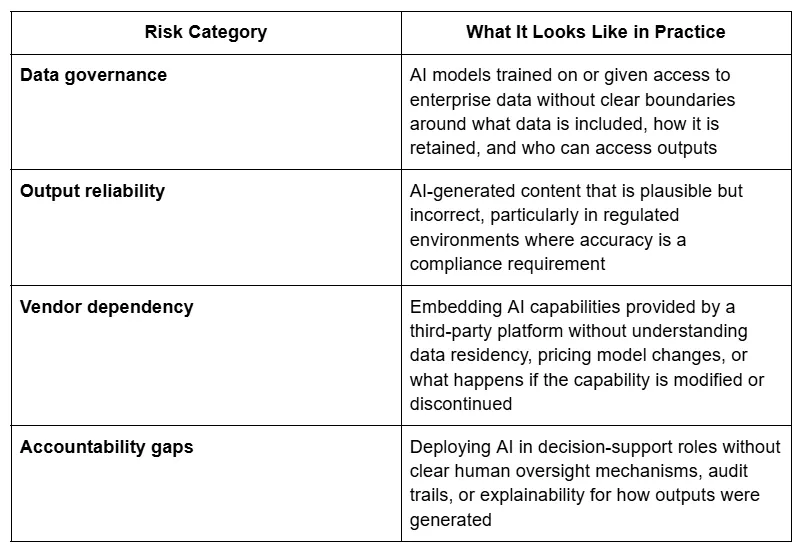
The accountability and data governance risks are particularly significant for Australian organisations operating under the Privacy Act, the Australian Government Information Security Manual (ISM), or sector-specific frameworks such as APRA CPS 234. An AI deployment that does not account for these obligations from the outset is likely tAo require costly remediation. Organisations working to achieve compliance need to treat AI governance as an architectural requirement, not an afterthought.
Data residency is an additional consideration. AI services hosted outside Australia may not meet the requirements of government or highly regulated enterprise clients. Selecting AI infrastructure that operates within Australian data centres is not optional for many organisations in these sectors.
How to Approach Generative AI Adoption Responsibly
The organisations that are getting the most value from generative AI in enterprise software are not necessarily the ones that moved fastest. They are the ones that were most deliberate about where AI was introduced, how it was governed, and how human oversight was maintained throughout.
A structured approach to adoption covers five areas:
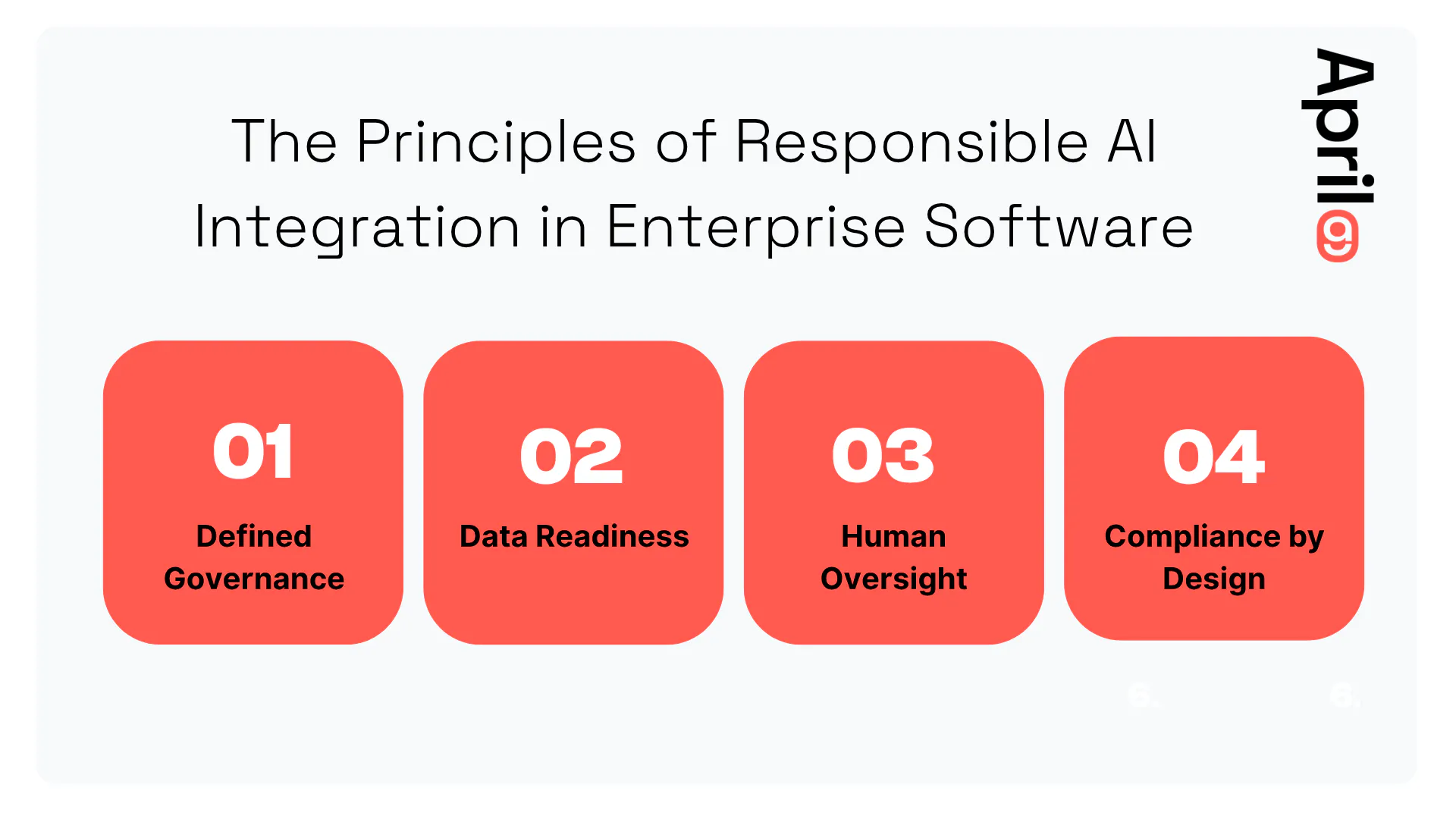
- Identify the right problems first. Not every enterprise process benefits from AI. Focus on high-volume, repetitive tasks with unstructured inputs and clear success criteria. Avoid deploying AI in processes where output errors carry significant regulatory or reputational risk until reliability can be demonstrated.
- Define governance before deployment. Establish who owns AI decisions, how outputs are reviewed, what audit trails are required, and how errors are identified and corrected. The CCHP project built AI ethics governance into the platform architecture from the start, including bias detection, decision explainability, and human override capabilities. That approach should be the standard, not the exception.
- Assess data readiness. Generative AI performs better when it is trained or fine-tuned on relevant, high-quality data. Many enterprise organisations have significant data quality problems that will limit AI performance if not addressed. A data readiness assessment before deployment is a prerequisite for meaningful results.
- Evaluate infrastructure for compliance. Understand where AI computation occurs, where data is stored, and whether those locations meet the organisation's regulatory requirements. For Australian government and regulated enterprise clients, this assessment is non-negotiable.
- Start with a validated scope. A proof of concept or pilot deployment in a contained, lower-risk part of the business generates the evidence base needed to make confident investment decisions for broader rollout. It also surfaces integration challenges and governance gaps before they become production problems.
What This Means for Custom Enterprise Software
Generative AI does not reduce the case for custom software development. In most enterprise contexts, it strengthens it.
Off-the-shelf platforms are incorporating AI features, but those features are designed for the broadest possible use case. They cannot be trained on an organisation's specific data, configured to reflect its compliance obligations, or integrated into its existing system architecture without significant customisation. The result is AI capability that is generic where it needs to be specific.
Custom software built with AI integration in mind from the outset allows the organisation to define exactly where AI is applied, on what data, within what governance framework, and connected to which workflows. That level of specificity is what delivers reliable, compliant, and genuinely useful AI capability, rather than a feature that sounds impressive in a vendor demonstration but delivers limited value in practice.
April9's Stack9 composable platform is designed to support AI integration as a component within a broader enterprise architecture. The platform includes an AI Assistant that gives workforce teams natural language access to business data, automating routine tasks and surfacing insight without requiring technical expertise. Because Stack9 is composable, AI capabilities can be embedded within the specific workflows where they add the most value, connected to the organisation's own data, and governed through the same audit and oversight mechanisms that apply to the rest of the system.
For organisations that have not yet formed a clear view on where AI fits in their enterprise software strategy, the starting point is not a technology decision. It is a process audit: identifying the workflows that carry the most manual overhead, the highest error rates, or the greatest volume of unstructured input, and assessing whether AI-assisted processing would deliver a measurable improvement. That analysis is what should drive the investment case, not the pressure to be seen to be doing something with AI.
The Responsible Path Forward
Generative AI is not a fixed capability. It is developing quickly and the enterprise software landscape will continue to shift as models improve, infrastructure matures, and governance frameworks catch up with deployment realities.
What is clear now is that Australian enterprises that approach AI adoption with the same rigour they apply to any significant technology investment, defined requirements, governance from the outset, validated evidence before broad deployment, and compliance addressed structurally rather than retrospectively, will be better positioned than those that move fast and attempt to fix problems later.
For a practical view of how AI-assisted automation is being applied to real business tasks today, the article Why Your Business Needs an AI Minion is a useful starting point. For organisations ready to move beyond the exploratory phase, April9 works with Australian enterprise and government clients to design, build, and deploy AI-integrated software that meets the performance, compliance, and governance requirements that matter in practice. Get in touch to start the conversation.