A poorly scoped software project will cost more, take longer, and deliver less than expected. Every time. The scope of a software project is the agreement between the business and the development team about what will be built, by when, and for how much. When that agreement is vague, incomplete, or built on assumptions, everything that follows is uncertain. When it is precise, documented, and agreed by all parties, the project has a defensible foundation.
This guide gives Australian business stakeholders a clear, step-by-step process for scoping a software project correctly before development begins. It is written for people who are not software developers but who are responsible for commissioning, approving, or governing a software investment.
What Scoping a Software Project Actually Means
Project scoping is the process of defining, documenting, and agreeing on exactly what a software project will deliver. A complete scope answers six questions:
- What problem is the software solving?
- Who will use it and what do they need to accomplish?
- What features and functions will the system include?
- What systems does it need to integrate with?
- What compliance and security requirements apply?
- What is explicitly excluded from this project?
Scoping is not the same as requirements gathering, though requirements gathering is part of it. Scoping also includes the boundaries of the project, the assumptions it rests on, the risks that need to be managed, and the criteria by which the project will be considered complete.
A scope document is the contract between the business and the development team. It is the document that makes a cost estimate credible, a timeline defensible, and a change request meaningful. Without it, every cost estimate is a guess and every timeline is an aspiration.
Why Poor Scoping Is the Most Expensive Mistake in Software Development
Poor scoping does not just cause inconvenience. It causes measurable financial damage across the entire project lifecycle. A BCG survey found that up to 49% of organisations report nearly one in three of their software projects encounter significant delays, with scope creep and unclear requirements consistently among the primary drivers.
The financial impact of undiscovered scope compounds as the project progresses:
- A requirement identified during scoping costs a document revision to address
- The same requirement identified during development costs rework, retesting, and schedule extension
- The same requirement identified after go-live costs an incident, a change programme, and operational disruption
The Project Management Institute found that scope creep affects over 30% of enterprise software projects and is the single most consistent driver of cost overruns. Over 60% of software project budgets go into design and development, which means every undiscovered requirement that surfaces during build directly inflates the largest cost category in the project.
The organisations that avoid these costs are not those with the most experienced developers. They are those with the most disciplined scoping process before development begins. Understanding why IT projects fail and what the most common root causes are provides important context for why scoping discipline matters before a single line of code is written.
Related Reading: What Is a Software Discovery Phase and Why Should You Never Skip It

Free Guide
A Practical Guide to Custom Software Projects
Real pricing, transparent processes, and an honest look at what it takes to build software that lasts before you commit to your next project.
Download the Free GuideThe Six Components of a Complete Project Scope
A complete software project scope covers six components. Missing any one of them creates a gap that will surface as a problem later in the project.
1. Problem statement A precise description of the business problem the software will solve. Not a description of the solution, but the problem. The problem statement anchors every scope decision that follows: if a proposed feature does not address the stated problem, it does not belong in this project.
2. User requirements A description of who will use the system, what they need to accomplish, and what a successful interaction looks like for each user type. User requirements are written in business language, not technical language. They describe outcomes, not implementation details.
3. Functional requirements The specific features and functions the system will include. Each functional requirement should be written as a testable statement: the system will do X when Y occurs. Vague requirements such as "the system should be user-friendly" cannot be tested, scoped, or costed.
4. Integration requirements Every system the new software needs to connect with, including what data flows between them, in what direction, and at what frequency. Integration requirements are consistently the most underestimated component of software project scope and the most common source of budget surprises during development.
5. Compliance and security requirements The regulatory and security obligations that apply to the system. For Australian organisations, these may include Privacy Act obligations, APRA prudential standards, ISO 27001 alignment, IRAP certification for government projects, or sector-specific frameworks. Compliance requirements identified during scoping are design inputs. Compliance requirements identified during build are expensive retrofits.
6. Out of scope definition An explicit list of what this project will not deliver. This is as important as the list of what it will deliver. A scope document that defines what is included but not what is excluded leaves room for assumptions that will surface as disputed scope changes during build.
The Step-by-Step Scoping Process
Scoping a software project well follows a structured sequence. The steps below apply to projects of any size, though the depth of each step scales with project complexity.
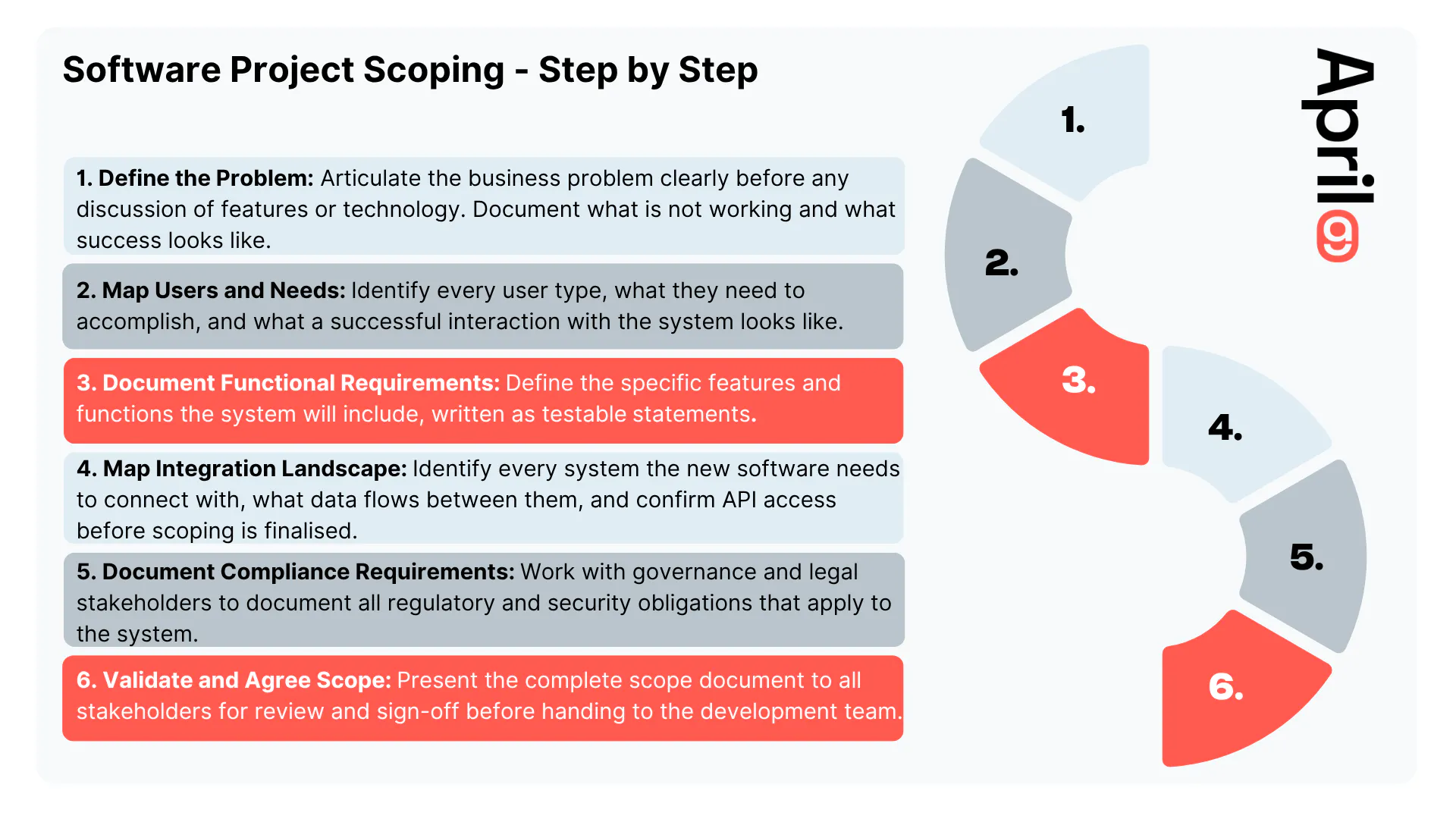
Step 1: Define the problem, not the solution Start with a clear articulation of the business problem before any discussion of features or technology. Bring together the key stakeholders who own the problem and document their view of what is not working, what the consequences are, and what success would look like. This step is frequently skipped by organisations that arrive at a development partner with a solution already defined. Skipping it produces solutions that solve the stated solution rather than the underlying problem.
Step 2: Map the users and their needs Identify every user type who will interact with the system. For each user type, document what they need to accomplish, what information they need to do their job, and what a good interaction with the system looks like. This step is the foundation of functional requirements and the primary input to user experience design.
Step 3: Gather and document functional requirements Working from the user needs documented in Step 2, define the specific features and functions the system needs to provide. Apply a feature prioritisation framework to classify requirements as must-have, should-have, could-have, or won't-have before finalising the scope. This prevents the scope from expanding to include every requirement identified rather than only those that belong in this project.
Step 4: Map the integration landscape Identify every system the new software needs to connect with. For each integration point, document what data needs to flow, in what direction, at what frequency, and what the technical connection mechanism will be. Where integrations with third-party systems are required, confirm availability and API access before scoping is finalised. Integration dependencies not confirmed before development begins are schedule risks.
Step 5: Document compliance and security requirements Work with the relevant governance, legal, or compliance stakeholders to document the regulatory and security obligations that apply to the system. These requirements need to be in scope from the start, not added later. For organisations working to achieve compliance under Australian regulatory frameworks, this step is as important as the functional requirements themselves.
Step 6: Define what is out of scope Explicitly document what this project will not deliver. This includes features that were considered and deferred, integrations that will be addressed in a later phase, and capability being retained in an existing system rather than replicated in the new one. Every out-of-scope decision should be documented with a brief rationale so it is clear the decision was made deliberately rather than overlooked.
Step 7: Validate and agree Present the complete scope document to all stakeholders for review and sign-off before it is handed to the development team. Every stakeholder who will be affected by the project should confirm that the scope reflects their requirements. Every stakeholder who will approve the budget should confirm the scope reflects what they are funding.
Common Scoping Mistakes and How to Avoid Them
The scoping mistakes that most consistently produce budget overruns and timeline blowouts follow recognisable patterns:
- Scoping the solution instead of the problem. Arriving at a development partner with a feature list rather than a problem statement produces a scope that reflects what the business thinks it wants rather than what the problem requires. The development partner builds what was asked for, and the business discovers after go-live that it was not what was needed.
- Leaving integration requirements to be figured out during build. Integration complexity is the most consistent source of budget surprises in software projects. Integrations not scoped before development begins surface as scope changes during build, at the cost and schedule of a mid-project redesign. This is one of the most common causes of expensive app development delays.
- Treating compliance requirements as a post-delivery checklist. Compliance requirements retrofitted into a system not designed to accommodate them are significantly more expensive than requirements designed in from the start. April9's ISO 27001 certification since 2021 and IRAP-aligned delivery experience exist precisely because compliance is a design input, not a final-step checkbox.
- Not defining what is out of scope. A scope document without explicit exclusions leaves room for stakeholders to assume features they did not raise are included. When those features are later requested, they arrive as scope changes rather than requirements that could have been evaluated and prioritised during scoping.
- Signing off on scope without the right stakeholders. A scope signed off by an IT manager without input from the operational teams who will use the system routinely surfaces requirements during UAT that should have been in the scope from the start. Every stakeholder group affected by the system should be represented in the scoping process.
Related Reading: How to Prioritise Features in a Custom Software Project Without Blowing the Budget
How to Know When Your Scope Is Ready
A scope document is ready to hand to a development team when it meets all of the following criteria:
- Every functional requirement is written as a testable statement that can be verified at UAT
- Every integration requirement has a confirmed technical connection mechanism or a documented assumption that needs to be validated during discovery
- Every compliance requirement has a named owner within the organisation who will validate that it has been met
- The out-of-scope definition has been reviewed by all stakeholders and no one has identified a requirement assumed to be included
- All stakeholders who will be affected by the system have reviewed and signed off on the document
- The development partner has reviewed the scope and confirmed it is sufficient to produce a reliable cost estimate and timeline
If any of these criteria are not met, the scope is not ready. Handing an incomplete scope to a development team produces a cost estimate no one can stand behind and a project no one can govern effectively.
For most projects of meaningful complexity, reaching this standard requires a formal discovery phase conducted by the development partner before build begins. Discovery produces the scope document described above as its primary output, along with the architecture design and integration map that give the cost estimate its reliability. The guide on how to choose a software development partner covers what to look for in a partner who will apply this level of rigour to the scoping process from the outset.
How April9 Helps Stakeholders Scope With Confidence
April9 works with Australian enterprise and government organisations to scope software projects with the rigour that reliable delivery requires. The scoping process April9 applies is grounded in structured discovery: a formal, time-bounded investigation of the business problem, user requirements, integration landscape, and compliance obligations that produces a documented scope, an architecture design, and a cost estimate grounded in understood requirements.
The Stack9 composable platform makes scoping more precise because the pre-built components that will form the foundation of the solution can be evaluated during scoping, reducing the architecture uncertainty that typically contributes to scope and cost risk. Stack9 reuses 80% of components across projects, reduces development time by up to 50%, and cuts implementation costs by up to 40% compared with fully bespoke development. The platform has been used by over 800,000 people globally and has supported more than $65 million in transactions.
April9 has been delivering custom software development for Australian enterprise and government organisations since 2016, with ISO 27001 certification held since 2021 and over 110 monitored security controls covering the full development environment. The Gallagher Bassett and Comcover FNOL platform delivered 30% faster claim submission and processing, a 45% reduction in time accessing applications, and zero security breaches, outcomes made possible by a scoping and discovery process that defined the architecture correctly before development began.
For Australian organisations ready to scope a software project with the discipline that reliable delivery requires, get in touch to start the conversation.