
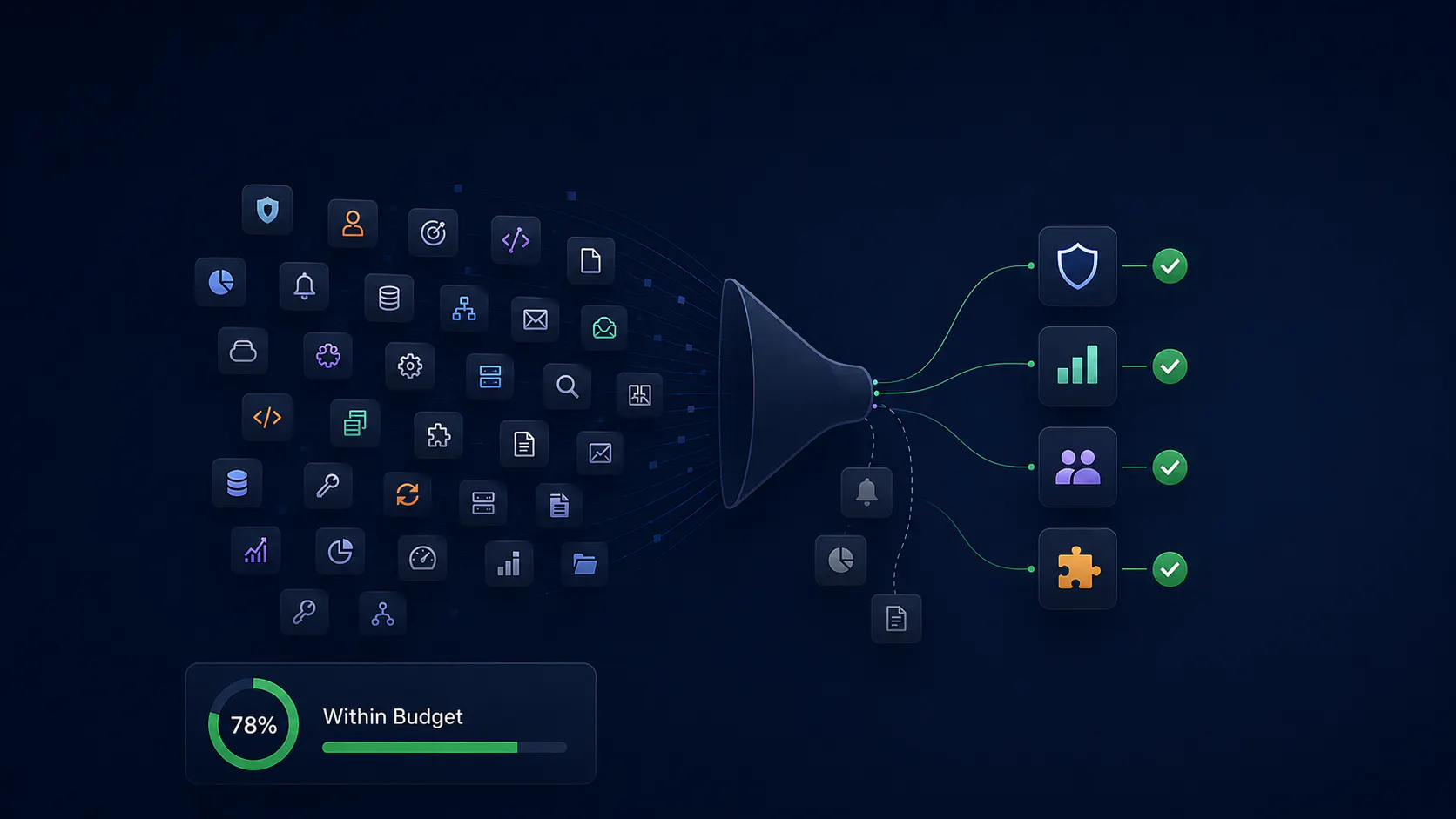
Poor feature prioritisation is one of the most consistent causes of budget overruns in custom software projects. A BCG survey found that up to 49% of organisations report nearly one in three software projects encounter delays, with scope creep and unclear requirements among the primary drivers. The fix is not building less. It is being deliberate about what gets built first, what gets built later, and what gets cut entirely.
This article provides a practical framework for Australian IT leaders, product owners, and business stakeholders to prioritise features effectively, handle competing stakeholder demands, and sequence development in a way that maximises business value without blowing the budget.
Why Feature Prioritisation Is Where Budgets Are Won or Lost
Scope creep affects over 30% of enterprise software projects according to the Project Management Institute. It rarely arrives as a single large addition. It accumulates incrementally: one extra report here, one additional integration there, one workflow variation that was not in the original brief. Each addition appears minor in isolation. Collectively they represent weeks of additional development, testing, and deployment work that was never costed.
The cost of scope creep compounds the later it is introduced:
- A feature added during the software discovery phase costs a fraction of the same feature added during build
- A feature added during build costs a fraction of one added during testing
- A feature identified after go-live may require a full remediation programme
Effective feature prioritisation establishes a clear, agreed process for evaluating every feature request against business value before it enters the scope. It also gives the project team and business stakeholders a shared language for scope decisions that removes the politics from what would otherwise be a subjective negotiation.
For a broader view of the challenges that derail enterprise software projects before prioritisation is even addressed, the five biggest challenges in enterprise application development covers the full landscape.
Related Reading: How to Accurately Price a Software Development Project
The Four Questions Every Feature Must Answer Before It Makes the List
Every feature added to a project scope should be evaluated against four questions. Features that cannot answer all four clearly are candidates for deferral or removal, not inclusion.
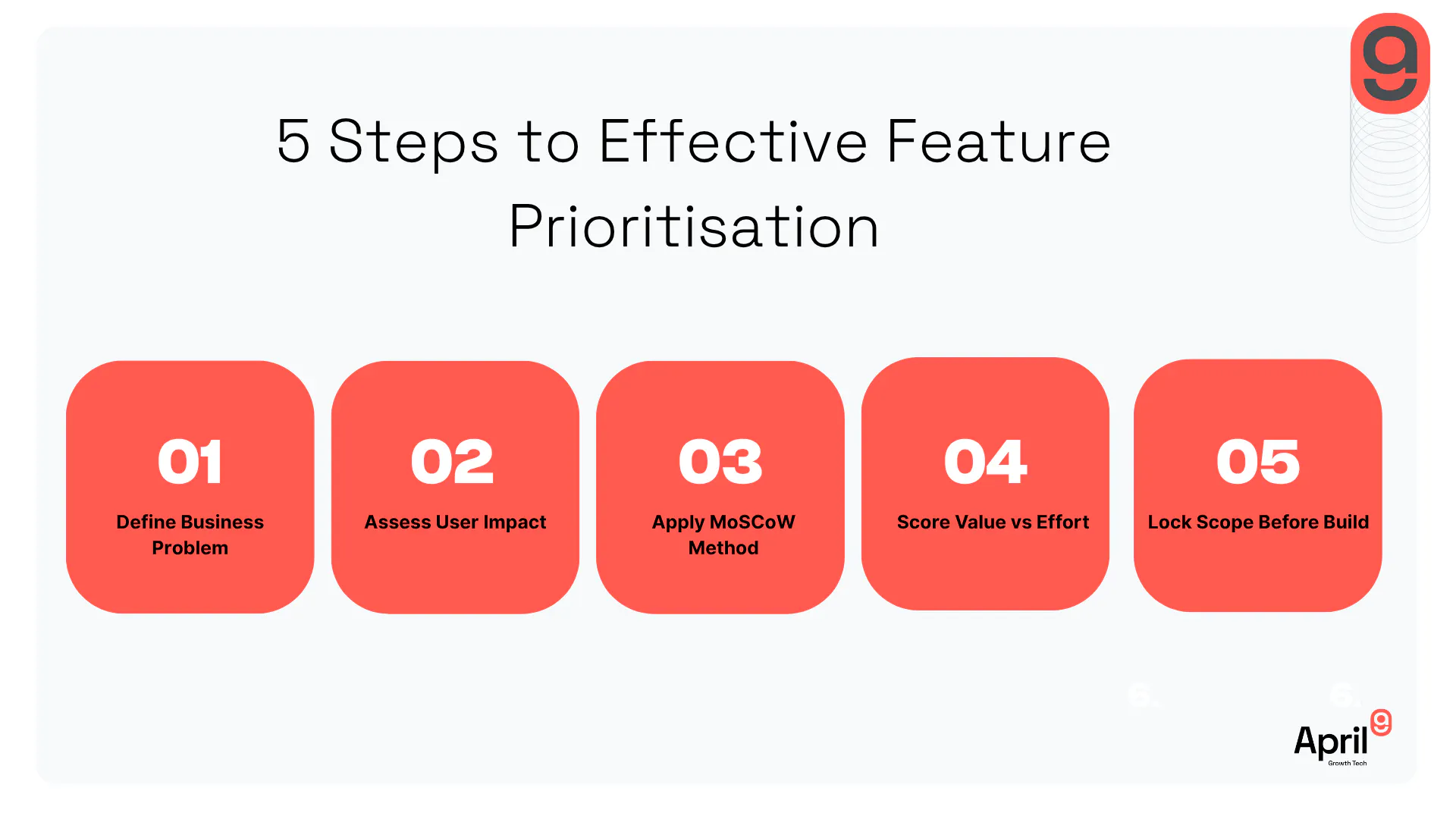
1. What business problem does this feature solve? Every feature should be traceable to a specific business problem or objective. If the answer is "it would be nice to have" or "another system does this," the feature has not passed the first test. Features that solve a clearly articulated problem with a measurable consequence belong on the list. Everything else belongs in a future backlog.
2. Who will use it and how often? A feature used by every user on every interaction has a fundamentally different value profile from one used by two administrators once a month. Usage frequency and user volume are the primary drivers of operational value. High-frequency, high-volume features should always be prioritised above low-frequency, low-volume ones regardless of how technically interesting they are.
3. What is the cost of not having it at launch? This question separates must-have features from nice-to-have ones. If the system can go live and operate effectively without a feature, that feature is a candidate for a later release. If its absence would prevent the system from serving its core purpose or require a manual workaround more expensive than building the feature, it belongs in the initial scope.
4. What is the development effort relative to the value delivered? Over 60% of software project budgets go into design and development. Some features deliver high value for relatively low effort. Others deliver marginal value for significant effort. Plotting features on a value versus effort basis quickly identifies what should be built first and what should be cut or deferred.
Prioritisation Frameworks That Work in Practice
Three frameworks are most useful for business stakeholders evaluating a large feature list without requiring technical expertise.
MoSCoW Method
Classifies every feature into one of four categories:
- Must Have - Essential for go-live. The system cannot function without it
- Should Have - Important but not critical at launch. A workaround exists
- Could Have - Desirable but low impact if absent. Deferred to a future release
- Won't Have - Explicitly agreed out of scope for this release
The MoSCoW method works best in a facilitated workshop with all stakeholders present, so classification decisions are made collectively rather than by individual advocates for specific features.
Value vs Effort Analysis
Evaluates each feature on business value against development effort:
- High value, low effort: build first
- High value, high effort: plan carefully, sequence strategically
- Low value, low effort: build only if time and budget permit
- Low value, high effort: cut or defer indefinitely
This framework is particularly useful for identifying quick wins that deliver disproportionate value early in the project.
Weighted Scoring
Assigns a numerical score to each feature based on weighted criteria such as business value, user impact, strategic alignment, compliance requirement, and development effort. Features are ranked by total score and the scope is drawn at the budget line. This produces the most defensible prioritisation decisions because every score is documented and every trade-off is explicit.
How to Handle Stakeholder Pressure for Features That Do Not Make the Cut
Feature prioritisation produces decisions that not every stakeholder will agree with. Managing those conversations without undermining the process or the relationships that depend on it is one of the most practically challenging aspects of project governance.
The most effective approach is to make the prioritisation criteria visible and agreed before individual features are evaluated. When stakeholders understand and accept the criteria upfront, a feature that does not make the cut is a consequence of the framework, not a personal decision made against them.
Key principles for managing stakeholder pressure:
- Present the MoSCoW or weighted scoring results as a collective output, not a unilateral IT decision
- Document every deferred feature in a product backlog with its prioritisation score recorded
- Communicate clearly that deferral is not rejection - deferred features have a defined pipeline for future releases
- Revisit the backlog at the start of each subsequent development cycle to demonstrate that deferred requirements are being actioned
April9's custom software development approach includes structured backlog management as a standard part of every engagement, ensuring deferred features are sequenced appropriately for future delivery rather than lost.

Free Guide
A Practical Guide to Custom Software Projects
Real pricing, transparent processes, and an honest look at what it takes to build software that lasts before you commit to your next project.
Download the Free GuideWhen to Build Now and When to Build Later
Even among features that have passed the four-question test and scored well in the prioritisation framework, not all should be built in the first release. The sequencing of features across releases is as important as the prioritisation of which features to include.
Build in the first release:
- Core workflow features that define the system's primary purpose
- Integration features that connect the system to the platforms it depends on
- Compliance and security features required before go-live in a regulated environment
- High-frequency features used by the most people in the most interactions from day one
Safely defer to a later release:
- Reporting and analytics features that add insight but do not affect core operational function
- Administrative and configuration features used infrequently by a small number of users
- Enhancement features that improve an existing capability without adding new capability
- Integrations with third-party systems not yet ready to connect during the current build cycle
This sequencing approach is the foundation of a minimum viable product strategy and one of the most effective ways to prevent expensive app development delays that occur when teams attempt to build everything before go-live.
April9's Stack9 composable platform supports this model directly. Because the platform is built from independently deployable components, new features can be added to a live system in subsequent releases without disrupting what is already in production. Stack9's 80% code reuse across projects means deferred features can be delivered in subsequent cycles at significantly lower cost and in shorter timeframes than a fully bespoke system would require.
Related Reading: Agile vs Waterfall Software Development - Which Suits Your Project
How April9 Manages Feature Prioritisation in Practice
April9 applies structured feature prioritisation as a standard component of the discovery phase that precedes every custom software engagement. During discovery, all requirements are gathered from stakeholders across the organisation, documented, and evaluated against the MoSCoW framework and value versus effort analysis before a scope is agreed.
The output of this process includes:
- A prioritised feature list with a clear rationale for every inclusion and every deferral
- A product backlog for features that did not make the initial scope
- A cost estimate based on the agreed scope rather than the full wishlist
- A governance document that makes board-level approval possible
For Australian enterprise and government clients where compliance obligations shape what must be included at launch, April9's ISO 27001 certification since 2021 and IRAP-aligned delivery experience mean compliance and security features are correctly prioritised as must-haves from discovery, rather than identified late and added as expensive scope changes during build.
April9's track record demonstrates what disciplined prioritisation delivers in practice:
- The Gallagher Bassett and Comcover FNOL platform achieved 30% faster claim submission and processing, a 45% reduction in time accessing applications, and zero security breaches since implementation
- The EasyAuto123 engagement delivered a 20% reduction in operational costs within a year
Both outcomes were possible because scope was defined with precision and delivered without the budget overruns that characterise poorly prioritised projects.
Prioritisation Is a Business Discipline, Not a Technical One
The most important insight about feature prioritisation is that it is not a technical decision. It is a business decision that happens to have technical implications. The criteria for prioritisation, the value assessment for each feature, and the sequencing decisions across releases are all business judgments that require business input and business ownership.
Development teams can facilitate the process and provide the effort estimates that inform the value versus effort analysis. But determining which features deliver the most business value, which are essential for launch, and which can be deferred without operational consequence belongs to the business stakeholders who understand the operational reality the system needs to serve.
Organisations that engage actively in the prioritisation process, apply a consistent framework, and resist the pressure to include everything in the first release will consistently deliver projects on time, on budget, and with a system that serves its core purpose from day one.
For Australian organisations ready to begin a custom software project with a disciplined approach to scope and feature prioritisation from the outset, April9 brings the facilitation expertise, delivery methodology, and composable platform to make it work. Get in touch to start the conversation.