
For many enterprise and government organisations, custom software development has long carried an uncomfortable risk profile too slow to keep pace with operational demands, too disruptive to existing infrastructure, and too difficult to align with evolving compliance requirements. Meanwhile, the pressure to modernise legacy systems, integrate disconnected platforms, and satisfy regulators keeps intensifying.
The composable applications market is projected to reach USD 11.8 billion by 2028, driven by organisations seeking a more resilient and adaptable approach to software delivery. But market momentum alone doesn’t resolve your organisation’s specific constraints. The strategic question isn’t whether to modernise, it's how to do so without introducing the project risk, cost overruns, and operational disruption that traditional development so often brings.
Stack9, April9’s composable software platform, is purpose-built to answer that challenge. Here’s how it works, and why it matters.
What is Composable Software?
Composable software treats applications as collections of interchangeable, reusable components rather than monolithic builds. Instead of rebuilding from the ground up for every new requirement, organisations leverage pre-built modules that integrate through standardised APIs enabling faster delivery, greater configurability, and lower long-term maintenance overhead.
The approach is built on five core principles:
- Modularity – Software is constructed from independent, reusable components that can be deployed or replaced without affecting the whole system.
- Interoperability – Components communicate through standardised APIs and interfaces, enabling seamless integration with existing platforms.
- Flexibility – Solutions are tailored by assembling the right components for each use case, without unnecessary development overhead.
- Scalability – Applications can expand or evolve as organisational needs change, without costly architectural overhauls.
- Efficiency – Eliminating redundant development effort compresses delivery timelines and preserves team capacity for higher-value work.
For organisations managing complex, multi-system environments with demanding compliance obligations, these principles translate into tangible operational and strategic outcomes.
What is Stack9?
Stack9 is April9’s composable software platform, built to accelerate custom development for enterprises, government bodies, and large organisations. It provides a structured environment where teams can create, manage, and deploy applications using modular components delivering the adaptability modern organisations require without compromising on security, compliance, or performance.
Key Features of Stack9
Pre-Built Modules and Components
Stack9 provides a library of pre-built, reusable components spanning authentication, data storage, API integrations, and UI elements. By eliminating repetitive groundwork, development teams can direct their capacity toward configuration, integration, and delivery rather than building common functionality from scratch.
No-Code and Low-Code Development
Stack9’s intuitive interface enables non-technical users to build and modify applications without writing code. Operations, finance, and service teams can configure solutions directly, reducing IT backlog and shortening delivery cycles without increasing headcount or dependency on specialist resources.
API-First Architecture
Stack9’s API-first design ensures seamless interoperability with existing systems, legacy applications, cloud platforms, and third-party services. Integration that would otherwise require costly custom development can be achieved efficiently eliminating data silos and enabling end-to-end automate business processes without a full infrastructure overhaul.
Cloud-Native and Scalable
Built on cloud-native architecture, Stack9 scales in line with organisational demand. Whether accommodating increased user load, expanded functionality, or new service requirements, applications maintain consistent performance without the need to re-architect as the organisation grows.
Security and Compliance
Stack9 incorporates robust security controls including role-based access management, encryption, and proactive threat identification. April9 holds ISO 27001 certification, and the platform is designed to support compliance with industry-specific regulatory frameworks including IRAP for government clients. Organisations operating in regulated environments can develop and deploy with confidence, knowing compliance obligations are addressed by design rather than as an afterthought.
Related reading: How Gallagher Bassett and the Department of Finance Enhanced Compliance and User Experience in Under a Year
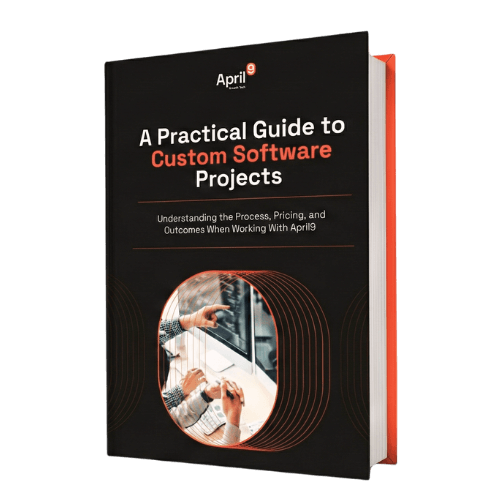
Free Guide
A Practical Guide to Custom Software Projects
Real pricing, transparent processes, and an honest look at what it takes to build software that lasts before you commit to your next project.
Download the Free GuideHow Stack9 Accelerates Custom Development
1. Faster Time-to-Market
Traditional software development projects routinely take months or years to deliver a production-ready application. Stack9 compresses that timeline through ready-made components, automated workflows, and a structured development environment enabling organisations to deploy new capabilities faster and respond to operational requirements without lengthy delivery cycles.
2. Smarter Resource Allocation
Ground-up development demands sustained investment in developer resources, infrastructure provisioning, and ongoing maintenance. Stack9’s reusable components and cloud-based services eliminate redundant effort, allowing teams to direct capacity toward solution design, integration, and continuous improvement rather than rebuilding common functionality.
3. Operational Resilience as Requirements Evolve
Enterprise and government environments are subject to regulatory change, policy shifts, and evolving operational demands that legacy architectures struggle to absorb. Stack9’s modular design means applications can be updated, extended, or reconfigured without major disruption protecting prior investment while maintaining the agility to respond as circumstances change.
4. Bridging Technical and Non-Technical Teams
A persistent failure mode in enterprise software projects is misalignment between IT and the business units the software is intended to serve. Stack9’s no-code and low-code capabilities allow business analysts, operations managers, and other non-technical stakeholders to participate actively in the development process improving requirements accuracy, reducing revision cycles, and ensuring the final solution reflects actual organisational needs.
5. Long-Term Maintainability and Reduced Technical Debt
Technical debt, the accumulated cost of shortcuts, workarounds, and outdated code is one of the most significant long-term risks in traditional development. Stack9 mitigates this by standardising components and enforcing development best practices, ensuring applications remain maintainable, auditable, and scalable as the organisation’s needs develop over time.
6. Capacity for Strategic Innovation
When delivery is streamlined, your team gains the capacity to focus on the work that drives meaningful organisational outcomes. Rather than managing infrastructure complexity and repetitive development tasks, teams can direct effort toward new capabilities, emerging technologies, and solutions that create lasting competitive and operational value.
Related reading: Surf Life Saving Foundation’s Digital Transformation: A 200% Improvement in Online Fundraising
Why Enterprises and Government Organisations Are Adopting Stack9
The organisations that benefit most from Stack9 are those managing complex, multi-system environments under regulatory scrutiny where the limitations of legacy software are a direct constraint on operational performance, compliance posture, and the ability to respond to change.
With Stack9, organisations are deploying composable software to:
- Enhance customer and stakeholder experience across digital channels
- Automate high-volume and manual business processes
- Enable real-time, data-driven decision-making at an organisational level
- Achieve and sustain compliance with industry and government regulatory requirements
- Develop and launch new digital products and services with greater speed and confidence
- Strengthen cybersecurity controls and data governance frameworks
The results speak to the strategic value of a well-executed composable software approach: April9 clients have achieved a 30% reduction in claims processing time, a 200% improvement in platform performance, and a 20% reduction in operational costs.
Ready to Move Beyond Legacy Constraints?
If your organisation is dealing with the operational drag of legacy systems, the complexity of integrating disparate platforms, or the compliance pressure of a regulated environment, composable software offers a proven path forward. Stack9 gives enterprise and government organisations the architecture to modernise at speed, without the risk profile of a traditional development programme.
Backed by April9’s deep expertise across government, healthcare, insurance, automotive, and more and underpinned by ISO 27001 certification Stack9 is built for the environments where getting it right actually matters.
Contact April9 today to discuss how Stack9 can support your organisation’s digital transformation goals.
Further reading: From Low-code to Hero Mode: Stack9 Platform Spotlight