Custom software development in Australia typically costs between $50,000 and $500,000 or more depending on project complexity, team composition, integration requirements, and compliance obligations. That range is wide because custom software is not a commodity. Every project is different, and the cost reflects the specific problem being solved, the systems it needs to connect with, and the regulatory environment it operates in.
For Australian IT leaders and business decision-makers commissioning custom software for the first time, understanding what drives that cost is more useful than a single figure. The organisations that budget most accurately are not those who received the lowest quote. They are those who understood what they were buying before they asked for a price.
This article provides a realistic cost breakdown by project type, explains the factors that move the number up or down, and identifies the hidden costs that most Australian organisations miss when building their initial budget.
Why Australian Custom Software Costs Differ From Global Benchmarks
When Australian organisations research custom software costs online, most of the figures they find reflect offshore or US market rates. These benchmarks are not directly applicable to Australian enterprise and government software projects for several reasons.
Australian development rates are higher than offshore alternatives but reflect significantly different risk and quality profiles. A development team in Australia operates under Australian employment law, within Australian privacy and security frameworks, and with direct accountability to Australian clients under Australian contract law. For government and regulated enterprise clients, these are not optional attributes. They are requirements.
Australian-specific compliance obligations also add cost that global benchmarks do not account for. IRAP certification for government projects, alignment with the Australian Government Information Security Manual, Privacy Act compliance for systems handling personal data, and APRA prudential standards for financial services organisations all impose design, testing, and documentation requirements that an offshore team working to a generic brief will not include by default.
The cost of not meeting these requirements is not a line item in a development quote. It is the cost of remediation, regulatory exposure, and in government contexts, the cost of a project that cannot go live because it has not been certified. That cost consistently exceeds the compliance investment it would have replaced.
Cost by Project Type: A Realistic Australian Breakdown
The most useful way to think about custom software cost in the Australian market is by project type. Within each type, scope, complexity, and integration requirements will move the cost up or down, but the ranges below reflect what Australian enterprise and government organisations are actually spending.
Simple workflow or process automation tools: $50,000 to $120,000 Systems that automate a defined internal process, manage a simple workflow, or replace a manual spreadsheet-based operation. Typically one to three user types, limited integration requirements, and a defined scope that does not change significantly during build. Examples include internal request management systems, simple case tracking tools, and process approval workflows.
Customer-facing portals and engagement platforms: $100,000 to $250,000 Portals that serve external users, members, or customers with self-service access to information, applications, or services. Typically requires integration with identity management, payment processing, or existing back-end systems. Complexity increases with the number of user types, the volume of data presented, and the compliance requirements that apply to user data.
Enterprise system replacements or modernisation programmes: $200,000 to $500,000+ Replacing or modernising a core operational system such as a claims management platform, case management system, ERP module, or regulatory reporting tool. Complexity is driven by the depth of the existing system's business logic, the integration landscape, the data migration requirements, and the compliance obligations that apply. Projects in this range typically involve multiple integrations, significant data migration, and a phased delivery approach.
Government and regulated enterprise platforms: $250,000 to $1,000,000+ Platforms built for government agencies or heavily regulated sectors such as financial services, healthcare, or insurance. Cost is driven by IRAP certification requirements, the security architecture required to meet government standards, the complexity of the workflow being digitised, and the number of agencies or stakeholders involved.
These ranges assume an Australian development team, full discovery and scoping, architecture and design, development, testing, UAT, and deployment. They do not include ongoing maintenance and support, which should be budgeted separately as an ongoing operational cost.
The Factors That Move the Number Up or Down
Within any project type, the final cost is determined by a combination of factors that are specific to the organisation's context. Understanding these factors before engaging a development partner produces more accurate budget planning.
Factors that increase cost:
- Integration complexity. Every system the new software needs to connect with adds design, development, and testing effort. A system with five external integrations costs significantly more than a standalone system, and the cost increases further if the connected systems have non-standard APIs or limited documentation
- Compliance requirements. IRAP certification, ISO 27001 alignment, Privacy Act compliance design, and APRA prudential standard adherence all add design, testing, and documentation effort that is not present in a non-regulated project
- Data migration scope. Migrating data from legacy systems adds analysis, cleansing, transformation, and validation effort that scales with the volume, complexity, and quality of the source data
- Number of user types. Each distinct user type adds user experience design, access control design, and testing effort. A system with six user types is materially more complex than one with two
- Custom reporting and analytics. Bespoke reporting requirements that go beyond standard dashboard capability add significant development effort, particularly when data needs to be aggregated across multiple source systems
Factors that reduce cost:
- Composable architecture. A development partner using pre-built, production-validated components for common capabilities reduces the custom build effort. April9's Stack9 composable platform reuses 80% of code across projects, reducing development time by up to 50% and cutting implementation costs by up to 40% compared with a fully bespoke build
- Well-defined scope. A project that enters development with a complete, agreed requirements specification and a mapped integration landscape produces fewer mid-project surprises and less rework than one where scope is defined progressively
- Phased delivery. Deferring non-essential features to later releases reduces the cost of the initial build and allows the organisation to validate the core system before investing in extended capability
- Existing infrastructure. Organisations with modern cloud infrastructure, well-documented APIs on existing systems, and clean data reduce the effort required for hosting setup, integration, and data migration
Related Reading: How to Accurately Price a Software Development Project
The Hidden Costs That Most Australian Organisations Miss
The quoted development cost is rarely the total cost of a custom software project. Several categories of cost are consistently underestimated or omitted from initial budgets, producing the budget surprises that generate difficult conversations with finance and executive leadership mid-project. Understanding what these hidden costs are before they arise is as important as understanding the project type benchmarks above. The broader picture of how much outdated software costs Australian businesses is a useful reference point here: the same organisations that underestimate custom software project costs also tend to underestimate the cost of the status quo that is prompting the investment.
- Discovery and scoping. A formal discovery phase that produces a requirements specification, architecture design, and integration map typically costs between $10,000 and $30,000 depending on project complexity. Organisations that skip this step do not save the cost. They absorb it as rework during development when the undiscovered complexity surfaces
- Change management and training. New software changes how people work. The cost of preparing staff, communicating the change, and training users to operate the new system is a project cost, not an operational overhead. Organisations that do not budget for it discover it during implementation when the project team absorbs the gap
- Post-launch support and maintenance. Over 60% of software project budgets go into design and development, but the ongoing cost of keeping the system operational, patched, and compliant is a multi-year commitment. A contingency budget of 10 to 20% of the total project cost covers unexpected issues during delivery. A separate annual maintenance budget of 15 to 20% of the development cost covers the ongoing operational obligation
- Compliance certification. For government projects requiring IRAP certification, or projects requiring ISO 27001 alignment or APRA compliance validation, the cost of the certification process itself needs to be in the budget. This includes the assessment fees, the remediation work if gaps are identified, and the documentation effort required to demonstrate compliance
- Integration maintenance. Every integration built during a project will require maintenance over its operational lifetime as connected systems change and update. This is a recurring cost that needs to be in the operational budget, not just the project budget
Free Guide
A Practical Guide to Custom Software Projects
Real pricing, transparent processes, and an honest look at what it takes to build software that lasts before you commit to your next project.
Download the Free GuideHow to Evaluate Cost Against Value, Not Just Price
The most common mistake in custom software procurement is evaluating cost as a single number rather than as a relationship between investment and outcome. A quote of $200,000 that delivers a system reducing operational costs by $150,000 per year is a fundamentally different investment from a quote of $180,000 that delivers a system requiring $50,000 per year in maintenance and $100,000 in compliance remediation eighteen months later.
The business case for custom software framework provides the structure for building that comparison honestly, including the current state cost, the future state cost, the risk-adjusted comparison, and the five-year total cost of ownership analysis that makes the investment decision defensible to finance and executive leadership. For IT leaders who need to present this analysis to a non-technical audience, the guide on communicating ROI and IT value to business stakeholders covers how to translate technical investment arguments into business outcome language that CFOs and COOs can evaluate and act on.
For Australian organisations evaluating whether custom software or a SaaS alternative is the right investment, the SaaS versus custom software comparison covers the full cost and capability trade-off in detail. The upfront development cost of custom software is higher than a SaaS subscription. The five-year total cost of ownership often is not, particularly for organisations with specific integration, compliance, or workflow requirements that SaaS platforms cannot accommodate without significant customisation.
Related Reading: What Is a Software Discovery Phase and Why Should You Never Skip It
How April9 Structures Custom Software Investment
April9 works with Australian enterprise and government organisations to structure custom software investment in a way that is transparent, defensible, and grounded in understood requirements rather than assumptions.
Every engagement begins with a formal discovery and scoping phase that produces the requirements specification, architecture design, integration map, and compliance assessment that make the subsequent cost estimate reliable. The estimate produced at the end of discovery is not a range. It is a figure grounded in a defined scope, with a documented rationale for every major cost component and a clearly identified contingency allocation for the uncertainty that remains.
The Stack9 composable platform changes the cost profile of custom software delivery in the Australian market. Because Stack9 reuses 80% of code across projects from pre-built, independently deployable components, the majority of each solution is assembled from architecture that has already been built, tested, and governed in previous engagements. Stack9 reduces development time by up to 50% and cuts implementation costs by up to 40%, making custom software investment accessible for organisations that have previously assumed bespoke development was beyond their budget.
April9 has held ISO 27001 certification since 2021, is an AWS Partner Select Tier and Microsoft Partner, and has delivered custom software development for Australian enterprise and government clients since 2016. The outcomes achieved for clients reflect what a well-scoped, well-executed custom software investment delivers in practice:
- The Gallagher Bassett and Comcover FNOL platform delivered 30% faster claim submission and processing, a 45% reduction in time accessing applications, and zero security breaches since implementation
- The EasyAuto123 engagement delivered a 20% reduction in operational costs within a year
- The Surf Life Saving Foundation platform delivered a 200% improvement in platform performance
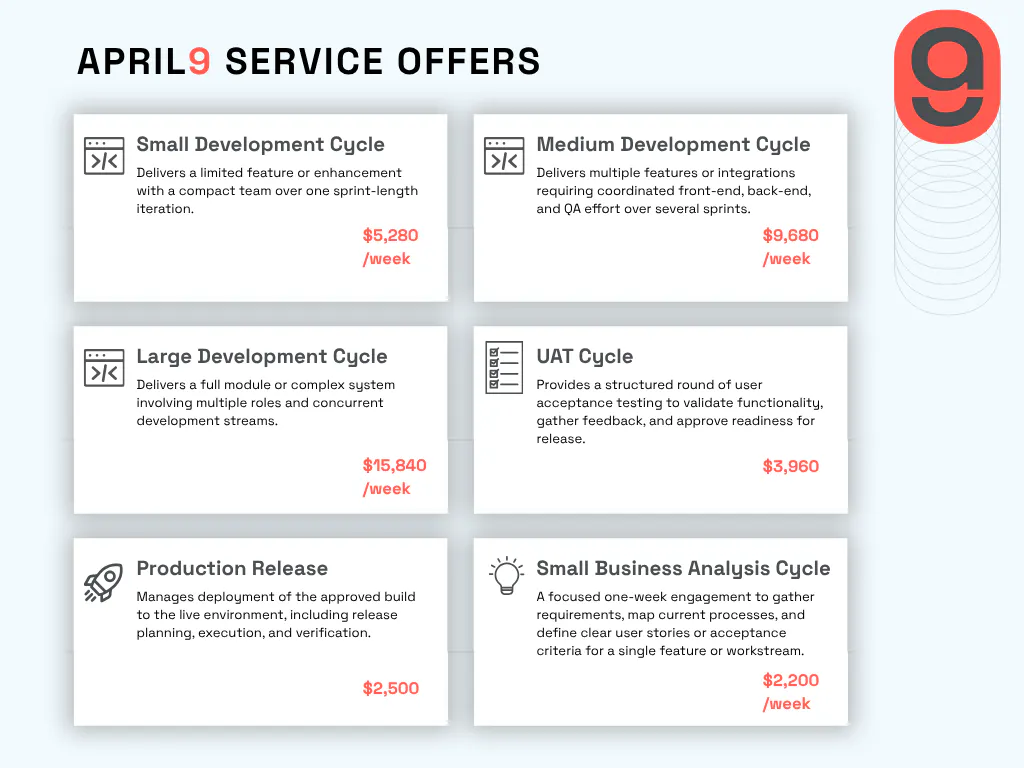
For Australian organisations ready to get a realistic, grounded cost estimate for their custom software project, get in touch to start the conversation.