
Switching software vendors is one of the most operationally complex decisions an Australian organisation can make. The decision itself is rarely the hard part. By the time it is made, the case for change is usually clear: the vendor has withdrawn support, the system can no longer meet the organisation's requirements, the contract terms are no longer acceptable, or the technology has fallen so far behind the market that staying is costing more than leaving.
The hard part is executing the transition without disrupting the business operations that depend on the system being replaced. A poorly managed vendor transition can produce data loss, compliance exposure, extended downtime, and a loss of institutional knowledge about how the outgoing system worked. Organisations that have experienced this describe it as creating a new set of problems while attempting to solve the original one.
The organisations that manage vendor transitions well share a common characteristic: they treat the transition as a programme of work in its own right, not as an afterthought to the decision to change. They plan before they give notice, manage the transition in phases, and address the risks that are specific to vendor transition rather than generic IT project risks.
This article covers the specific risks that vendor transitions introduce, the planning and execution approach that prevents disruption, and the characteristics of an incoming partner that give a transition the best chance of success.
Why Vendor Transitions Fail
The failure modes in vendor transitions are well established and consistent across industries. Understanding them before the transition begins is the most effective way to avoid them.
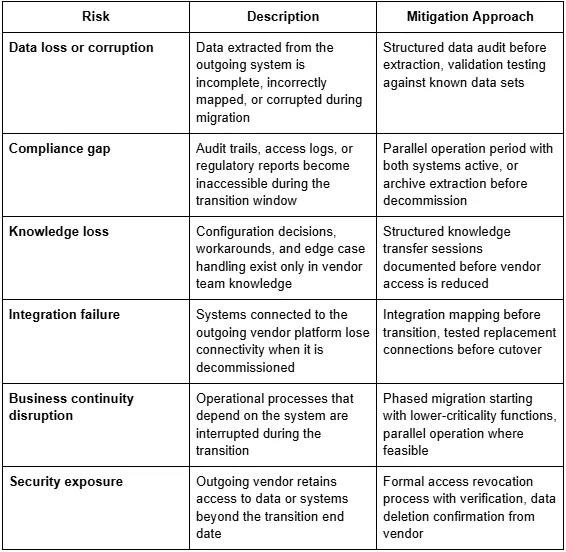
Underestimating dependency depth. Most organisations discover during a transition that their dependency on the outgoing vendor is deeper than they understood before the process began. Custom integrations, proprietary data formats, undocumented workflows, and institutional knowledge held by vendor staff all become visible at the point of exit. Organisations that have not mapped these dependencies before giving notice find themselves negotiating from a weak position during the transition period.
Inadequate knowledge transfer. The outgoing vendor holds knowledge about how the system was configured, what workarounds are in place, and how edge cases are handled that may not exist anywhere in the client organisation's own documentation. Without a structured knowledge transfer process, this information walks out the door with the vendor's team. The cost of reconstructing it in the new environment can be significant.
Data migration underestimated. Data migration in a vendor transition is consistently the most complex and most underestimated workstream. The outgoing system's data model may not map cleanly to the incoming system. Data quality problems that were invisible in the current environment become visible during extraction. Mandatory data that is needed in the new system may not exist in a usable format in the old one.
Compliance continuity overlooked. The transition period between the outgoing and incoming systems is a compliance risk window. Audit trails may be interrupted. Access controls may not be fully replicated in the new system from day one. Regulatory reporting that depends on the outgoing system may become inaccessible before the new system is ready to produce it.
Timeline pressure driving poor decisions. Vendor contract end dates create pressure that can cause organisations to compress timelines in ways that introduce risk. A transition that is rushed to meet a contract deadline is more likely to produce data loss, inadequate testing, and insufficient training than one that is given the time it requires.
The Risks That Need to Be Managed
A vendor transition introduces a specific set of risks that differ from those in a standard software implementation. Identifying them explicitly allows the transition plan to address them structurally rather than reactively.
Before You Give Notice: What to Do First
The most important principle in vendor transition management is that the work begins before notice is given, not after. Once notice is served, the relationship with the outgoing vendor changes. Cooperation that was previously routine may become conditional. Access to documentation and system knowledge that was freely available may become subject to negotiation. The transition period is the wrong time to discover that critical information is missing.
Before deciding whether to transition or modernise, the guide on modernise or replace legacy software provides a useful framework for confirming the decision is the right one for the specific system and organisational context. Once the transition decision is confirmed, the pre-notice preparation covers four areas:
System dependency mapping. A complete map of everything that connects to or depends on the outgoing system. This includes direct integrations with other platforms, scheduled data exports, reporting pipelines, user access structures, and any automated processes that interact with the system. This map becomes the blueprint for what needs to be replicated or replaced in the new environment.
Data audit. A structured assessment of the data held in the outgoing system: what data exists, what format it is in, what quality it is at, and what transformation will be required to move it to the new environment. This assessment surfaces data quality problems that need to be addressed before migration and identifies any data that exists in the outgoing system in a format that may not be extractable without vendor cooperation.
Documentation inventory. An assessment of what system documentation exists within the client organisation versus what exists only within the vendor. This identifies the knowledge transfer requirements that need to be built into the transition agreement. For organisations with hidden costs of legacy software problems driven by poor documentation, this step is often confronting but essential.
Transition agreement negotiation. Before notice is served, the terms of the transition period need to be agreed. This includes the duration of the transition period, the vendor's obligations for data export and knowledge transfer, the format in which data will be provided, the access controls that will apply during the transition, and the vendor's obligations for data deletion after the transition is complete.
Free Playbook
Legacy System Modernisation: A Practical Playbook for IT Decision Makers
Practical frameworks and real-world case studies to help you modernise outdated systems without the usual transformation headaches.
Download the Free PlaybookManaging the Transition Without Disrupting Operations
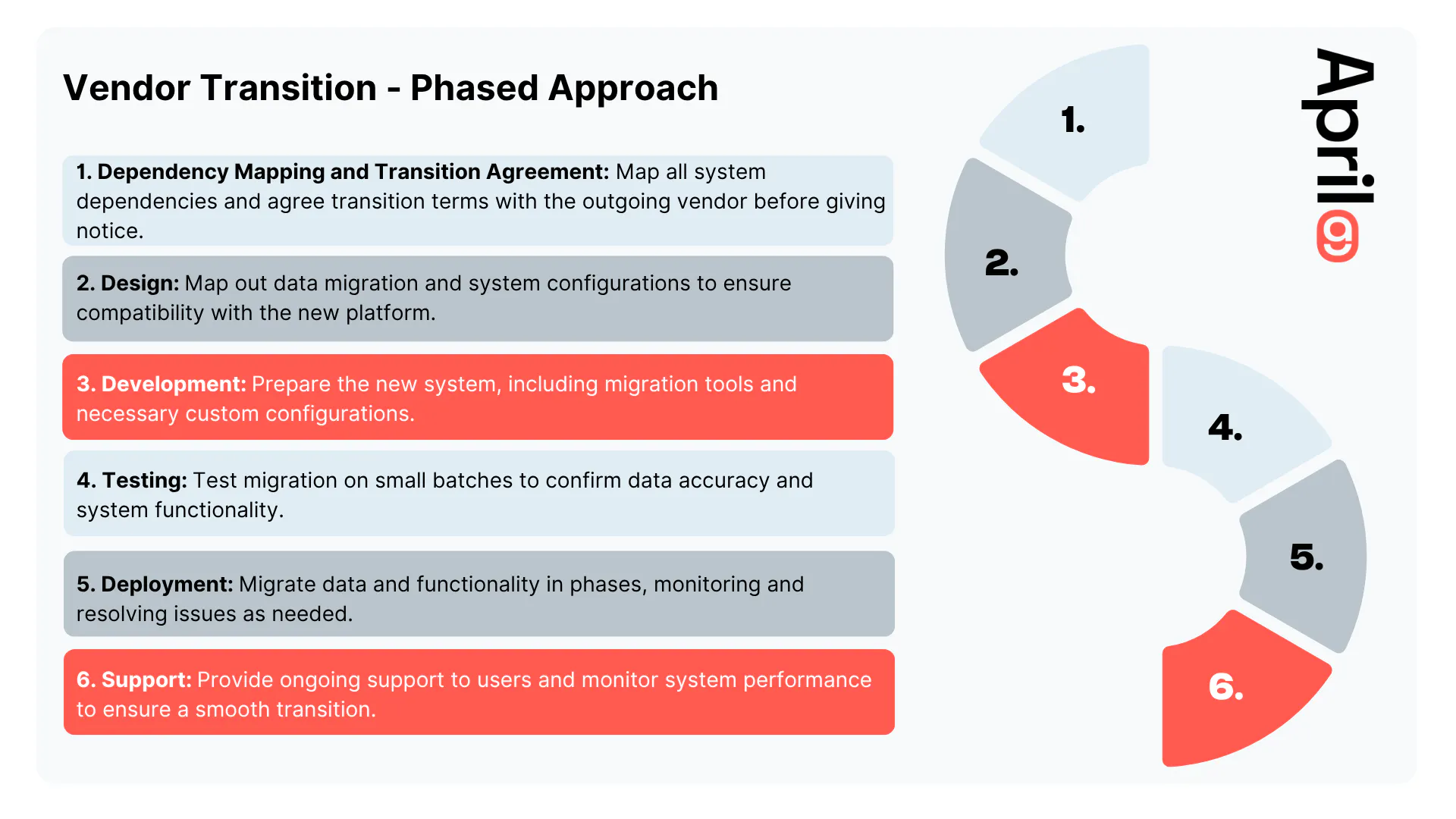
The transition execution approach that most consistently protects business continuity is a phased migration that moves capability from the outgoing to the incoming system incrementally rather than through a single cutover event.
A phased approach sequences the migration from the lowest-criticality functions to the highest, allowing the organisation to build confidence in the new system and the transition process before the most operationally sensitive functions are moved. Problems that arise in early phases are resolved within a contained scope rather than across the full operational estate.
The six-phase approach used in secure software deployment applies directly to vendor transition: planning and dependency mapping, design of the new environment, development and configuration, testing against known data and workflow scenarios, phased deployment starting with lower-criticality functions, and post-transition monitoring and support.
For most vendor transitions, a parallel operation period, where both the outgoing and incoming systems are active simultaneously for a defined window, is the most effective way to validate the new system before the outgoing system is decommissioned. Parallel operation allows the organisation to compare outputs between systems, identify discrepancies before they affect operations, and maintain business continuity if the incoming system requires adjustment before it can carry full operational load.
Data Migration: The Most Underestimated Workstream
Data migration deserves specific attention in a vendor transition because it is where transitions most commonly encounter problems that affect the reliability of the new system and the completeness of the organisation's records after the transition is complete.
The data migration workstream in a vendor transition covers four stages:
Extraction. Getting data out of the outgoing system in a complete, accurate, and usable format. This requires the vendor's cooperation and, in many cases, specific extraction tools or exports that need to be agreed as part of the transition terms. Data held in proprietary formats may require transformation before it can be used in the new environment.
Cleansing. Addressing data quality problems identified during the pre-notice audit. Data that has accumulated in a legacy system over years often contains duplicates, inconsistencies, deprecated records, and fields that were populated inconsistently across different time periods. Migrating uncleaned data reproduces these problems in the new system. The legacy software migration guide covers data cleansing methodology in detail as part of the broader migration process.
Mapping and transformation. Converting data from the outgoing system's structure and format into the structure required by the incoming system. Where the two systems use different data models, this transformation requires careful design and testing to ensure that data relationships are preserved and that no information is lost or misattributed during the conversion.
Validation. Testing that the migrated data in the new system is complete, accurate, and correctly structured. Validation should be performed against known reference data sets before the new system is used for live operations, so that any discrepancies are identified and resolved before they affect business decisions or compliance records.
Protecting Compliance and Security During the Transition
The transition period between the outgoing and incoming systems creates specific compliance and security risks that need to be addressed in the transition plan rather than discovered during execution.
For Australian organisations operating under the Privacy Act, APRA prudential standards, or government security frameworks, the following obligations apply during the transition period regardless of which system is being used:
- Audit trail continuity: Regulatory obligations to maintain audit trails do not pause during a system transition. The transition plan needs to address how audit records from the outgoing system are archived and how the incoming system picks up the audit trail from a defined point in time
- Access control management: User access to the outgoing system needs to be managed during the transition period to ensure that access is not broader than required and that it is formally revoked at the end of the transition. The incoming system's access controls need to be validated before go-live to ensure they correctly reflect the organisation's current access requirements
- Data residency: If the outgoing vendor holds data in locations that meet Australian data residency requirements, the incoming environment must meet the same requirements. This needs to be verified before the transition begins, not after
- Vendor data deletion: After the transition is complete and the outgoing vendor's access is revoked, formal confirmation of data deletion from the vendor's systems should be obtained and retained for compliance purposes
Organisations working to achieve compliance under regulated frameworks should treat compliance continuity as a design requirement of the transition plan, not an outcome to be validated after the transition is complete. Similarly, the security controls that apply during the transition period should meet the standards covered in the enhance cybersecurity framework, with particular attention to access management and data handling during the handover window.
Choosing the Right Incoming Partner
The quality of the incoming software partner is the single most significant factor in whether a vendor transition produces a better outcome than the situation it replaced. An incoming partner that delivers a technically superior system but manages the transition poorly will create disruption that undermines the business case for change. An incoming partner that manages the transition well but delivers a poorly architected system will reproduce the problems that made the transition necessary in the first place.
The characteristics of an incoming partner that give a vendor transition the best chance of success include:
- Transition experience: Specific experience managing vendor transitions, not just software implementations. Vendor transitions have a distinct set of risks and requirements that differ from greenfield or brownfield implementations. A partner that has managed them before brings knowledge of where transitions commonly encounter problems and how to prevent them
- Data migration capability: Demonstrated capability in complex data migration, including extraction from legacy systems, cleansing, mapping, and validation. This is where transitions most commonly fail, and it requires specific technical and process expertise
- Compliance understanding: Understanding of the compliance obligations that apply during the transition period in the organisation's specific regulatory environment. For government, insurance, and healthcare clients, this is a non-negotiable capability requirement
- Architecture quality: A commitment to building the incoming system with the architectural discipline that prevents the organisation from finding itself in the same position again in five years. The hidden costs of poor software architecture are a direct consequence of choosing an incoming partner on price rather than architectural quality
- Knowledge transfer approach: A structured methodology for extracting knowledge from the outgoing vendor and the client organisation's own team, and incorporating it into the design and configuration of the new system
The guide on how to choose a software development partner covers the ten questions every Australian organisation should ask before selecting an incoming development partner, including questions about ISO 27001 certification, delivery methodology, and IP ownership that are directly relevant to a vendor transition context.
April9 brings all of these capabilities to vendor transition engagements. The Stack9 composable platform provides the architectural foundation for the incoming system, with pre-built components for the capabilities that appear most commonly in legacy replacement programmes. April9's ISO 27001 certification and IRAP-aligned delivery experience ensure that the compliance and security requirements of the transition period are addressed as design inputs rather than afterthoughts. And April9's custom software development capability means that where the incoming system requires capabilities beyond the Stack9 platform's pre-built components, they can be built and delivered within the same governed, auditable architecture.
Making the Transition a One-Time Event
The goal of a vendor transition is not simply to escape the problems created by the outgoing system. It is to arrive in a new environment that does not reproduce those problems, so that the organisation is not managing the same transition again in five years.
That outcome requires two things: a transition executed with sufficient rigour to protect business continuity and data integrity throughout the change, and an incoming system built with sufficient architectural discipline to remain fit for purpose as the organisation's requirements evolve.
Organisations that get both right make the vendor transition a one-time event. Organisations that get the transition right but compromise on the incoming system's architecture begin accumulating the conditions for the next transition from the day the new system goes live.
For Australian organisations ready to plan a vendor transition or evaluate an incoming partner, April9 brings the transition management experience, compliance depth, and architectural rigour to make the change well. Get in touch to start the conversation.