
Enterprise resource planning systems are the operational backbone of most mid-to-large organisations. They manage finance, procurement, inventory, human resources, and in many cases, the data flows that connect every significant business function. When they work well, they are invisible. When they stop working well, they become one of the most visible and costly problems an organisation can carry.
For Australian CFOs, COOs, and IT leaders, the decision to replace a legacy ERP is rarely straightforward. The system is deeply embedded. Data migration is complex. Business continuity during transition is a genuine concern. And the investment required is significant enough to attract board-level scrutiny. These are legitimate considerations, but they frequently function as reasons to defer rather than reasons to evaluate properly.
The organisations that defer ERP replacement indefinitely do not avoid the cost. They redistribute it across maintenance budgets, operational workarounds, compliance remediation, and the growing gap between what the business needs and what the system can deliver. By the time the decision becomes unavoidable, the cost of staying has often exceeded the cost of replacing by a margin that was not visible when the deferral decision was made.
This article provides a structured framework for building the business case for ERP replacement, understanding what the decision actually costs on both sides, and evaluating the replacement options available to Australian organisations.
Why Legacy ERP Systems Become a Strategic Liability
ERP systems are not static investments. They are implemented at a point in time to address the requirements of the organisation as it exists at that moment. As the organisation grows, acquires new entities, enters new markets, and faces new regulatory obligations, the ERP must grow with it. Legacy ERP systems, particularly those implemented more than a decade ago, were not designed for the integration requirements, data volumes, compliance frameworks, or operational complexity that most Australian enterprises now face.
The transition from operational asset to strategic liability tends to follow a recognisable pattern. It begins with workarounds: manual processes introduced to compensate for things the system cannot do natively. Those workarounds multiply as requirements change and the system remains static. Integration patches connect the ERP to newer platforms through bespoke connections that require ongoing maintenance. Reporting limitations force analysts to export data into spreadsheets for manipulation outside the system. Compliance obligations that the architecture cannot meet require parallel processes to satisfy auditors.
Each of these conditions is a signal that the system is no longer serving the organisation. Collectively, they represent how legacy systems hold businesses back from the operational efficiency and strategic agility that the business requires. The question is not whether the system has become a liability. It is how large that liability has grown and whether the business case for replacement has become clear enough to act on.
The Real Cost of Keeping Your Legacy ERP Running
The cost of a legacy ERP system is consistently underestimated because it is distributed across categories that are rarely aggregated into a single figure. The direct costs are visible: licence fees, support contracts, hardware maintenance, and the IT staff hours consumed by system administration. The indirect costs are not.
The indirect costs of a legacy ERP include:
- Manual workaround labour: The staff time consumed by processes that exist only because the system cannot perform them automatically. This includes manual data entry, spreadsheet reconciliation, report compilation, and the cross-checking required when data from multiple systems is inconsistent
- Integration maintenance: The ongoing cost of maintaining bespoke connections between the legacy ERP and the modern platforms the organisation has introduced around it. Each connected platform update requires re-engineering of the integration, often at unplanned cost
- Compliance remediation: The cost of satisfying regulatory obligations that the system's architecture cannot meet natively, including manual audit processes, parallel record-keeping, and periodic remediation projects required when audit gaps are identified. For organisations working to achieve compliance under Australian frameworks, this cost is particularly pronounced where the ERP was not designed with current obligations in mind
- Technical debt accumulation: Each workaround and bespoke integration added to extend the ERP's life contributes to a growing technical debt burden that makes every subsequent change more expensive and more risky
- Delayed decision-making: The opportunity cost of management decisions that are made on data that is delayed, incomplete, or requires manual reconciliation before it is reliable enough to act on
- Staff productivity loss: The time consumed by slow system performance, unintuitive interfaces, and the training burden imposed on new staff who must learn a system that requires significant institutional knowledge to operate effectively
When these indirect costs are quantified alongside the direct costs, the total cost of ownership of a legacy ERP over a five-year horizon is typically significantly higher than the annual direct cost suggests. The hidden costs of legacy software framework provides a structured approach to surfacing these costs in a form that is credible to finance and executive leadership.
When Modernisation Is Not Enough
Before the replacement decision is made, the question of whether modernisation can address the system's limitations at lower cost and risk needs to be answered honestly. For some legacy ERP systems, targeted modernisation such as rehosting to cloud infrastructure, adding an integration layer, or upgrading specific modules can extend useful life and reduce operating cost without the disruption of full replacement.
For many legacy ERPs, particularly those more than ten to fifteen years old, modernisation cannot address the structural limitations that are driving the operational drag described above. The architectural problems are foundational, not peripheral. Tightly coupled components that cannot be updated independently. Data models that were designed for a simpler operational context and cannot be extended without significant re-engineering. Integration architectures built for a world of on-premises systems that cannot accommodate modern API-first connectivity. Compliance frameworks that were not part of the original design and cannot be embedded retroactively without restructuring core components.
The decision framework in legacy system replacement versus modernisation provides a structured assessment tool for determining which path is appropriate for a specific system. The key signal that replacement is warranted rather than modernisation is a pattern of problems that are architectural in origin: not poor performance that can be addressed by better infrastructure, but structural constraints that prevent the system from meeting current and future requirements regardless of the infrastructure it runs on.
Building the Business Case: A Framework for CFOs and COOs
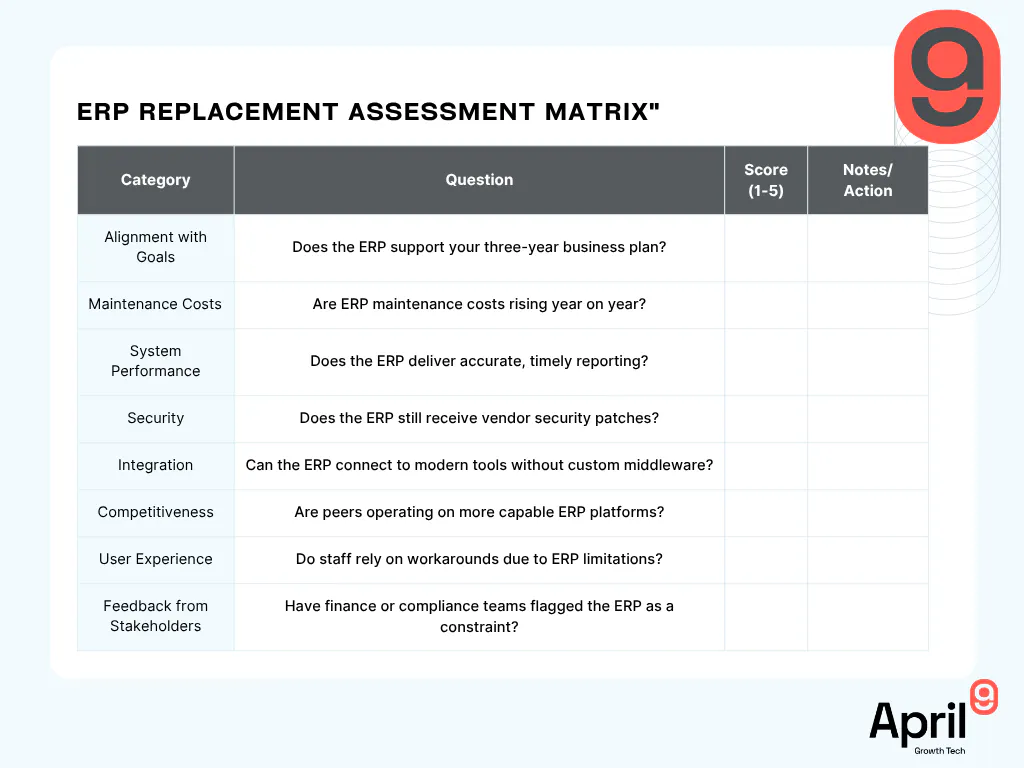
The business case for ERP replacement needs to be constructed in terms that resonate with financial and operational leadership, not just with the IT function that has been living with the system's limitations. The most common reason ERP replacement decisions are deferred is not that the technical case is unclear. It is that the financial case has not been articulated in terms that non-technical decision-makers can evaluate against the investment required. The guide on communicating ROI and IT value to the business provides a useful framework for translating technical investment arguments into business outcome language that CFOs and COOs can evaluate and act on.
A credible business case for ERP replacement covers six elements:
1. Current state total cost of ownership The full cost of the existing system over the next five years, including direct costs, indirect costs as quantified above, and the projected trajectory of each cost category. Most legacy ERP costs are increasing year on year as the gap between the system's capability and the organisation's requirements widens. Projecting that trajectory forward makes the cost of inaction visible.
2. Replacement investment The full cost of the replacement programme, including software licensing or development cost, implementation, data migration, integration, testing, training, and change management. A credible replacement cost estimate requires a defined scope and a realistic assessment of complexity. The guide to how to price a software project covers the cost categories and estimation approaches that produce defensible figures.
3. Five-year total cost comparison The comparison of current state total cost of ownership against replacement investment plus projected operating cost of the new system over five years. For most legacy ERP situations, this comparison favours replacement within a two to three year payback period when indirect costs are included in the current state figure.
4. Risk-adjusted analysis The probability-weighted cost of the risks associated with each path. The risks of replacement include implementation complexity, data migration integrity, and business continuity during transition. The risks of continuation include escalating maintenance cost, compliance exposure, security vulnerability, and the growing strategic gap between system capability and business requirement. Both sides of this analysis need to be present for the comparison to be credible.
5. Strategic capability gained The business capabilities that become available following replacement and that are not available with the current system. This includes integration with modern platforms, real-time data-driven decision-making capability, compliance by design, and the ability to scale operations without a proportional increase in system administration overhead.
6. Measurement framework The specific metrics that will be used to assess whether the replacement has delivered the expected value. Defining these before the investment is approved creates accountability and provides the evidence base for future technology investment decisions.
Free Playbook
Legacy System Modernisation: A Practical Playbook for IT Decision Makers
Practical frameworks and real-world case studies to help you modernise outdated systems without the usual transformation headaches.
Download the Free PlaybookERP Replacement Options and What Each Delivers
Once the business case for replacement is established, the next decision is what the replacement looks like. Australian organisations replacing legacy ERP systems have three primary options, each with different cost, risk, and capability profiles.
Off-the-shelf ERP platforms Established ERP platforms such as SAP, Oracle, Microsoft Dynamics, and similar products offer broad functionality, vendor support, and an established implementation ecosystem. They are appropriate for organisations whose operational requirements are well-served by standard ERP functionality and whose integration requirements can be met through the platform's native connectors. The risks include high licensing cost, significant implementation complexity, and the risk that standard functionality does not adequately serve the organisation's specific operational requirements, leading to customisation that reintroduces the architectural debt the replacement was meant to eliminate.
Custom-built ERP replacement A purpose-built system designed around the organisation's specific operational requirements, integration environment, and compliance obligations. This approach delivers maximum fit with organisational requirements and full IP ownership but requires greater upfront investment and a longer implementation timeline. It is most appropriate for organisations with operational complexity or regulatory requirements that standard ERP platforms cannot adequately address, and where the long-term cost of customising a standard platform would exceed the cost of building a fit-for-purpose system. April9's custom software development capability is built for this use case.
Composable platform approach A modular architecture that assembles ERP capability from pre-built, independently maintainable components rather than implementing a monolithic system. This approach reduces implementation time and cost compared to full custom development while delivering greater fit with organisational requirements than standard off-the-shelf platforms. April9's Stack9 composable platform delivers this approach, reusing 80% of code across projects and reducing development time by up to 50%. For organisations that need the flexibility of a custom solution without the full investment of a greenfield build, the composable approach represents a materially different cost and risk profile from either alternative.
Managing the Risk of ERP Replacement
ERP replacement carries genuine implementation risk, and acknowledging that risk is part of building a credible business case rather than a reason to avoid it. The organisations that manage ERP replacement well share several common characteristics in how they approach the project.
They invest in discovery before committing to a solution. A thorough assessment of the current system, its data model, its integration dependencies, and its compliance obligations, conducted before a replacement approach is selected, surfaces the complexity that determines which replacement option is most appropriate and what the implementation will actually require. Organisations that skip this step consistently encounter surprises during implementation that extend timelines and inflate cost.
They plan data migration as a first-class workstream. Data migration is consistently the most underestimated component of ERP replacement. The quality and consistency of data in the legacy system directly determines the complexity of migration and the reliability of the new system from day one. A dedicated data migration plan, with clear ownership, validation criteria, and testing protocols, is a prerequisite for a replacement project that delivers on its objectives.
They implement in phases where operationally possible. A phased replacement approach that migrates capability incrementally, starting with lower-risk functions and progressing to core operational processes, keeps implementation risk bounded and allows the organisation to maintain business continuity throughout the transition. The legacy software migration guide covers the phased implementation approach in detail.
They define success metrics before go-live. The business case established the expected outcomes of the replacement. Defining the specific metrics that will measure those outcomes before go-live creates accountability and provides early warning if the implementation is not tracking toward the expected value.
How April9 Approaches ERP Replacement
April9 works with Australian enterprise and government organisations on ERP replacement programmes that require both the technical depth to design and build complex systems and the governance discipline to deliver them within the compliance frameworks that regulated industries require.
The Stack9 composable platform provides the architectural foundation for ERP replacement engagements, delivering the core capabilities that appear most consistently across replacement programmes: finance and accounting integration, procurement and inventory management, workflow automation, case management, reporting and analytics, document management, and identity and access management. Because these capabilities are delivered as composable components rather than a monolithic application, they can be assembled, extended, and configured to reflect the organisation's specific operational requirements without the customisation overhead that drives cost and complexity in standard ERP implementations.
April9's track record across government, insurance, and enterprise environments demonstrates the delivery capability required for complex replacement programmes. The Gallagher Bassett and Comcover FNOL platform delivered 30% faster claim submission and processing, a 45% reduction in time spent accessing applications, and zero security breaches since implementation, all within a government IRAP compliance framework. The EasyAuto123 modernisation delivered a 20% reduction in operational costs within a year. These outcomes were not achieved by replacing complexity with more complexity. They were achieved by replacing architectural constraint with a governed, maintainable system designed for the operational requirements it needed to serve.
April9 holds ISO 27001 certification and delivers government projects within IRAP-aligned security frameworks, meaning that the security and compliance baseline required for ERP replacement in regulated environments is already established rather than requiring separate assessment.
The Cost of Waiting Is Not Zero
The business case for ERP replacement is not primarily an argument for spending money. It is an argument for stopping the accumulation of cost that occurs when the decision is deferred. Every year a legacy ERP continues to operate beyond its useful architectural life, the costs described in this article compound: maintenance expenditure increases, integration debt accumulates, compliance exposure grows, and the gap between system capability and business requirement widens.
The organisations that manage this decision well are those that build the business case honestly, including both sides of the cost equation, and make the investment decision based on a five-year total cost comparison rather than a comparison of the immediate project cost against the comfort of the status quo.
For Australian organisations ready to build that business case or to evaluate their replacement options, April9 brings the advisory depth and delivery capability to support both. Get in touch to start the conversation.