
The way software is released to production is as consequential as the way it is built. A system that has been thoroughly tested, validated through UAT, and approved for go-live can still cause significant disruption if the release itself is poorly planned. Uncontrolled deployments that push all changes to all users simultaneously, without monitoring, rollback capability, or a structured cutover sequence, are one of the most preventable sources of post-launch incidents in enterprise software.
The Australian Signals Directorate's 2022-23 cyber threat report confirms that attackers in Australia exploit one in five critical vulnerabilities within 48 hours. For organisations releasing software without a structured security and deployment framework, this window of exposure is not theoretical. It is an operational reality.
A software release strategy is the structured plan that governs how tested, approved software moves from the development environment to the live production environment. It defines the sequence of steps, the monitoring approach, the rollback triggers, and the communication plan that protect the business and its users during the transition. This article explains what a release strategy covers, why it matters for Australian IT leaders, and what a well-managed release looks like in practice.
Why the Release Is as Risky as the Build
Most software project risk management focuses on the build: requirements gaps, integration complexity, scope creep, and testing coverage. The release phase receives less attention and consistently produces the incidents that result in post-launch remediation, user disruption, and unplanned downtime.
The risks that arise during release are distinct from those that arise during build:
- Environment differences. A system that behaves correctly in a development or staging environment may behave differently in production, where data volumes, user load, integration endpoints, and infrastructure configurations differ from those in the test environment
- Dependency failures. A release that updates one component of a complex system can produce unexpected failures in components that were not part of the change, particularly in tightly coupled architectures where dependencies are not fully mapped
- Data migration errors. Releases that include database schema changes or data migration steps carry the risk of data loss, data corruption, or data inconsistency if the migration is not executed correctly and validated before users access the system
- Security exposure. Every release creates a window of potential vulnerability between when software is deployed and when it has been confirmed to be operating correctly under production conditions. Understanding the full range of security risks that apply during this window is why penetration testing is frequently scheduled around major system releases and infrastructure changes
- Inadequate rollback capability. A release that encounters a critical issue in production cannot be safely reversed without a pre-planned rollback procedure. Organisations that discover they need to roll back during a production incident and have not planned for it face a significantly more complex and time-consuming recovery
Understanding these risks is the starting point for designing a release strategy that addresses them structurally rather than reactively.
What a Software Release Strategy Actually Covers
A software release strategy is not a deployment checklist. It is a governance document that defines how every release will be planned, executed, monitored, and, if necessary, reversed. A complete release strategy covers:
- Release scope: What is included in this release, what is explicitly not included, and what the relationship is between this release and the releases that follow
- Environment management: How the staging environment is maintained to accurately reflect the production environment, so that testing conducted in staging is representative of production behaviour
- Release sequence: The specific steps of the deployment in the order they will be executed, including any database migration steps, configuration changes, and integration updates
- Monitoring plan: What metrics will be monitored immediately after deployment, what thresholds constitute a concern, and who is responsible for monitoring during the release window
- Rollback triggers and procedure: The specific conditions that will trigger a rollback decision, who holds the authority to make that decision, and the specific steps required to reverse the deployment safely
- Communication plan: How affected staff, users, and stakeholders will be informed before the release, during the release window, and after go-live confirmation
A release strategy that covers all of these elements gives the team a shared reference point throughout the release and a governance framework that prevents critical decisions from being made under pressure without adequate information.
Related Reading: What to Expect During a Custom Software Project - A Timeline Breakdown
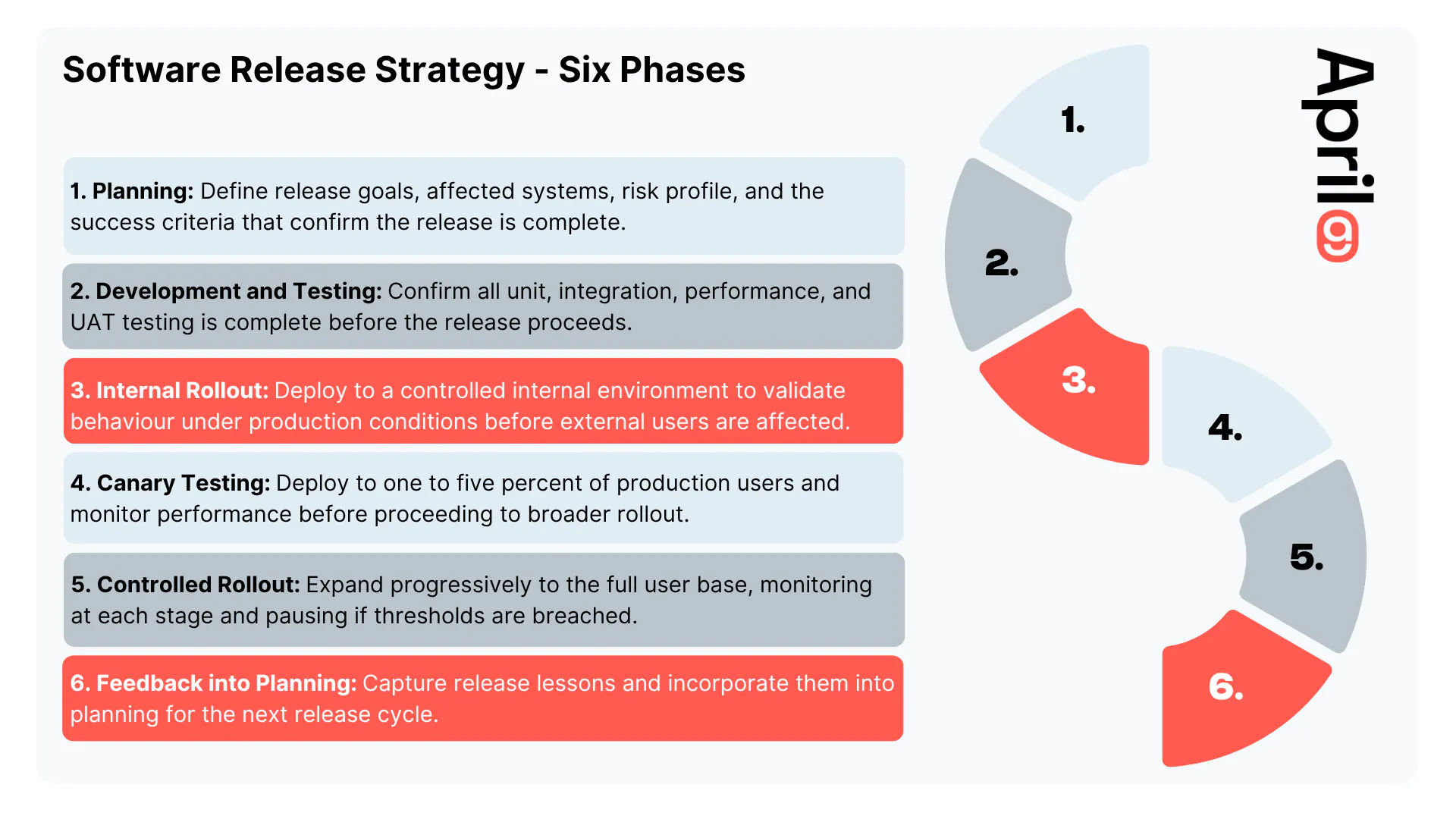
The Six Phases of a Safe Software Release
The U.S. Cybersecurity and Infrastructure Security Agency (CISA), in collaboration with the FBI and the Australian Cyber Security Centre (ACSC), published a framework for safe software deployment that outlines six phases applicable to any software release. These phases provide a structured sequence that reduces deployment risk at each stage.
Phase 1: Planning Define the release goals, identify the users and systems affected, map the potential risks, and establish the success criteria that will confirm the release has succeeded. A release without defined success criteria cannot be formally declared complete.
Phase 2: Development and testing Confirm that all testing has been completed to the required standard before the release proceeds. This includes unit testing, integration testing, performance testing, and user acceptance testing. A release that proceeds with known unresolved issues is accepting risk that should be quantified and approved before go-live, not discovered after it.
Phase 3: Internal rollout Before releasing to external users or the full production user base, deploy the software to a controlled internal environment where it can be validated under production conditions. This phase surfaces environment-specific issues that did not appear in staging before they affect operational users.
Phase 4: Deployment and canary testing Deploy the software to a small subset of production users, typically between one and five percent of the total user base, and monitor their experience before proceeding to broader rollout. Issues identified during canary testing affect a small number of users and can be resolved before the full user base is exposed.
Phase 5: Controlled rollout Expand the release progressively to the full user base, monitoring at each expansion stage and confirming that performance, stability, and security metrics remain within acceptable thresholds before proceeding. A controlled rollout that encounters problems can be paused, investigated, and resolved with the majority of users still on the previous version.
Phase 6: Feedback into planning After the release is confirmed successful, capture the lessons from the release process, including what worked, what caused friction, and what the monitoring data revealed, and incorporate those lessons into the planning for the next release.

Free Guide
A Practical Guide to Custom Software Projects
Real pricing, transparent processes, and an honest look at what it takes to build software that lasts before you commit to your next project.
Download the Free GuideThe Release Approaches Available and When to Use Each
Within the structured six-phase framework, several specific release approaches determine how the software change is introduced to the production environment. The right approach depends on the size and risk profile of the change, the architecture of the system, and the organisation's tolerance for disruption during the transition.
Big bang release All changes are deployed to all users simultaneously at a defined cutover point. This is the highest-risk approach and is appropriate only for small, well-understood changes with a clearly defined and tested rollback procedure. For large or complex releases, a big bang approach concentrates all risk at a single point in time with no ability to limit exposure if problems arise.
Phased rollout Changes are deployed progressively to increasing proportions of the user base over a defined period. Issues identified early in the rollout affect fewer users and can be resolved before the full user base is exposed. This is the approach recommended by the CISA-ACSC framework and the one most appropriate for enterprise software releases where business continuity is a primary concern.
Feature flags New functionality is deployed to the production environment but kept inactive until it is explicitly enabled for specific users or user groups. This separates the deployment of code from the release of features, allowing the technical deployment risk to be managed independently from the business decision about when to make functionality available.
Blue-green deployment Two identical production environments are maintained: one serving live traffic and one receiving the new release. Once the new environment is confirmed operational, traffic is switched from the old environment to the new one. Rollback is instantaneous if problems are identified, because traffic can be switched back without reversing a deployment.
For Australian organisations working to achieve compliance under regulatory frameworks, the release approach needs to be documented and approved as part of the release strategy, not selected ad hoc on the day of release. A security-first approach to deployment is equally important, with the goal of enhancing cybersecurity posture throughout the release lifecycle, not just during the build phase.
What Business Stakeholders Need to Do Before Go-Live
A software release is not only a technical event. It is an organisational transition that requires preparation from the business as well as the development team. Business stakeholders who treat go-live as the development team's responsibility and are surprised by its operational implications are consistently those whose post-launch period is most disrupted.
The business stakeholder's role before go-live includes:
- Confirming UAT completion and sign-off. The go-live decision should rest on a documented UAT outcome, not an assumption that testing is complete. The user acceptance testing guide covers what a properly concluded UAT phase looks like and what the formal sign-off should include
- Communicating the change to affected staff. Users who are not aware that a system is changing before it changes will generate support requests that could have been prevented. Communication should happen with enough lead time for users to ask questions and receive answers before go-live
- Confirming support availability during the release window. The immediate post-launch period generates the highest support volume of any point in the system's life. Business stakeholders need to confirm that first-line support is resourced and briefed before the release proceeds
- Agreeing the go-live timing. Releases that occur during peak operational periods create more disruption than releases timed for lower-traffic windows. The release timing should be agreed between the business and the development team as part of the release plan, not decided on the day
- Understanding the rollback decision authority. If a critical issue is identified immediately after go-live, a rollback decision may need to be made quickly. Business stakeholders need to understand who holds that authority and how the decision will be communicated
Related Reading: How to Ensure Your Software Project Stays on Time and on Budget
How April9 Manages Software Releases in Practice
April9's release management approach follows the CISA-ACSC six-phase framework and is governed by a security and deployment methodology that exceeds standard industry practice. As an ISO 27001 certified organisation since 2021, April9 maintains over 150 security controls under active management, covering the full development and deployment lifecycle. The release process is governed by a formal Change Management Policy that requires releases to be assessed, approved, and scheduled before any deployment to production proceeds.
Every April9 release includes a defined release scope, environment validation, a canary or phased rollout approach where operationally appropriate, real-time monitoring during the release window, a documented rollback procedure with defined triggers, and a post-release review that feeds lessons into subsequent release planning.
The Stack9 composable platform supports safer releases structurally. Because Stack9 components are independently deployable, a release can target a specific component of the system without requiring the entire application to be redeployed. This contains the risk of each release to the component being changed rather than distributing it across the full system. Stack9 reduces development time by up to 50% and cuts implementation costs by up to 40%, which means the release cadence can be maintained without the overhead that prevents teams from applying proper release governance under time pressure.
April9 delivers custom software development for Australian enterprise and government clients across government, insurance, healthcare, and corporate environments. The Gallagher Bassett and Comcover FNOL platform achieved zero security breaches since implementation, an outcome that reflects the security-first release and deployment approach applied throughout the engagement, not just in the build phase.
For Australian organisations ready to approach their next software release with a structured strategy that reduces deployment risk and protects business continuity, get in touch to start the conversation.