
Most software projects that run over time and over budget do not fail because of bad developers. They fail because of decisions made, or not made, before development began. Unclear requirements, undiscovered integration complexity, stakeholders who are not available when decisions are needed, and scope that grows without being governed are the consistent drivers of project overruns. None of these are technical problems. All of them are preventable.
A BCG survey found that up to 49% of organisations report nearly one in three of their software projects encounter significant delays. The Project Management Institute found that scope creep affects over 30% of enterprise software projects and is the single most consistent driver of cost overruns. These numbers reflect a systemic problem with how projects are set up, not an inherent limitation of software development.
This article identifies the practices that consistently keep software projects on time and on budget, explains what business stakeholders need to do throughout the project to support those outcomes, and describes what to do when a project starts to drift before it becomes a crisis.
Why Software Projects Fail to Deliver on Time and on Budget
Understanding the root causes of project failure is the starting point for preventing it. The causes are well documented and consistent across industries and project types.
The six most common reasons IT projects fail are:
- Unclear or undefined goals. When the project does not have a precise definition of what success looks like, the team cannot work toward it and stakeholders cannot evaluate whether it has been achieved
- Poor communication. Misaligned expectations between the business and the development team, delayed responses to questions, and insufficient reporting all create the conditions for misaligned delivery
- Inadequate resourcing. Teams that are under-resourced for the scope they are asked to deliver produce late results, because the timeline assumed a capacity that was never available
- Scope creep. Requirements that grow during development without being formally assessed, approved, and scheduled inflate cost and timeline without being visible in progress reporting
- Integration complexity discovered late. Dependencies on third-party systems that were not mapped before development began surface during build as unplanned work
- Wrong problem being solved. Systems built to a specification that did not accurately reflect the business need fail adoption even when they are delivered on time
Each of these causes is addressable. None of them require the organisation to accept overruns as inevitable.
The Seven Practices That Keep Projects on Track
The organisations that consistently deliver software projects on time and on budget apply seven practices that address the root causes above. These are not advanced techniques. They are disciplined execution of fundamentals that are frequently skipped under delivery pressure.
1. Invest in discovery before committing to a build The software discovery phase is the single most effective investment an organisation can make in project predictability. Discovery produces a documented scope, a mapped integration landscape, a compliance assessment, and a cost estimate grounded in understood requirements rather than assumptions. Projects that begin without discovery consistently encounter the surprises that discovery would have surfaced, at the cost and schedule of a project already underway.
2. Define scope precisely and govern changes formally Every feature in scope should be documented as a testable requirement before development begins. Every change request that arises during development should be assessed for its impact on timeline and cost, approved by the relevant authority, and scheduled before any development work on it starts. A change management process that is documented before the project begins is infinitely more effective than one assembled in response to the first request.
3. Select a development partner with a proven methodology The methodology a development partner uses determines how work is planned, how risks are surfaced, and how progress is made visible. A partner without a structured methodology produces unpredictable outcomes. A partner running two-week Agile sprints with defined sprint reviews, clear escalation paths, and transparent progress reporting gives the business regular visibility and regular opportunities to identify and address emerging issues before they become significant. The guide to how to choose a software development partner covers the methodology questions every Australian business should ask before signing.
4. Map and confirm integrations before development begins Integration dependencies that are identified during build require redesign of components that were built without accounting for them. Every system the new software needs to connect with should be identified during discovery, the technical connection mechanism confirmed, and access to test environments secured before development begins. This single practice eliminates one of the most consistent sources of mid-project schedule pressure.
5. Prioritise features rigorously and defer what is not essential Over 60% of software project budgets go into design and development. Every feature in scope adds to that cost and extends the timeline. The software feature prioritisation discipline of classifying features as must-have, should-have, could-have, or won't-have before development begins, and resisting the pressure to include everything in the first release, is one of the most effective budget and timeline controls available.
6. Ensure business stakeholders are available and responsive Development teams working in two-week sprints cannot absorb sustained decision delays without sprint slippage. Every day a stakeholder decision is delayed is a day of development capacity that cannot be recovered. Business stakeholders who commit to attending sprint reviews, responding to questions within agreed timeframes, and making scope decisions promptly are making a direct contribution to on-time delivery.
7. Build compliance and security requirements in from the start Compliance requirements identified after development has begun are expensive to accommodate: they require rework of components that were built without accounting for them, and they introduce testing cycles that were not in the original timeline. For Australian organisations operating under the Privacy Act, APRA standards, or government security frameworks, achieving compliance needs to be a design input from the discovery phase, not a final-step checklist.
Related Reading: How to Scope a Software Project - A Guide for Business Stakeholders

Free Guide
A Practical Guide to Custom Software Projects
Real pricing, transparent processes, and an honest look at what it takes to build software that lasts before you commit to your next project.
Download the Free GuideThe Business Stakeholder's Role in Project Success
Project delivery is a shared responsibility. A development partner who executes a flawless delivery process cannot compensate for a business stakeholder who is unavailable, indecisive, or disengaged. The practices above require active participation from the business throughout the project, not just at the start and at go-live.
The specific contributions business stakeholders need to make at each project phase are:
During discovery and scoping:
- Make the right people available for requirements workshops
- Provide access to existing system documentation and process maps
- Make prioritisation decisions on features when trade-offs are required
- Review and sign off on the scope document before development begins
During development:
- Attend sprint reviews at the end of each two-week cycle
- Respond to questions and clarification requests within agreed timeframes
- Review completed features as they are delivered rather than deferring all feedback to UAT
- Escalate scope change requests through the formal change management process rather than raising them informally with the development team
During UAT:
- Allocate sufficient user time for testing - UAT cannot be done adequately in the margins of a full working day
- Log issues in the agreed format with sufficient detail for the development team to replicate and resolve them
- Make go/no-go decisions promptly against agreed acceptance criteria
During deployment and go-live:
- Communicate changes to affected staff with enough lead time for training and adjustment
- Be available to support users during the immediate post-launch period
- Escalate production issues through the agreed support channel
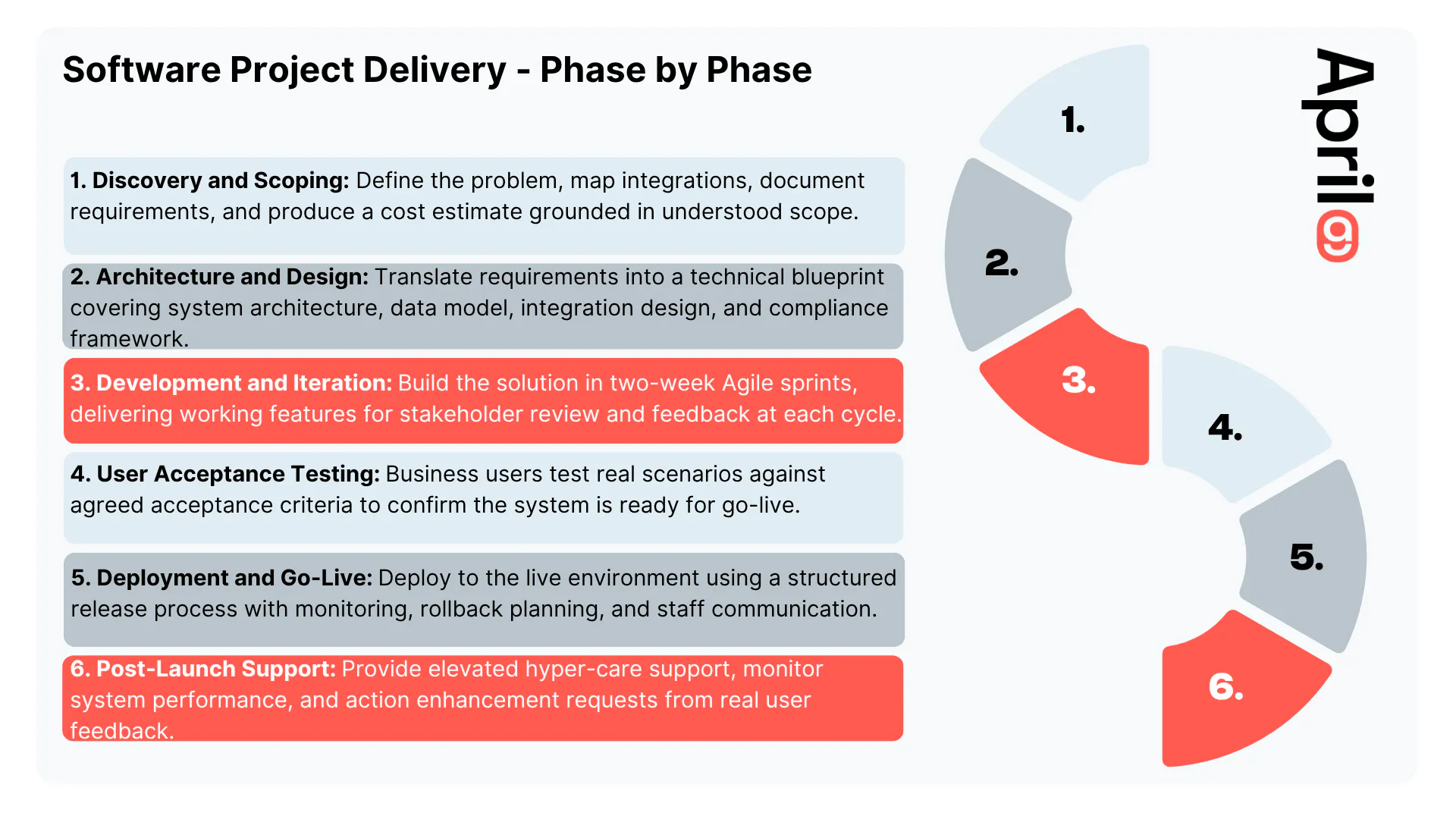
For a detailed view of what each project phase involves and what is required from the business at each stage, what to expect during a custom software project covers the full timeline from discovery through to post-launch support.
What to Do When a Project Starts to Slip
Even well-run projects encounter unexpected challenges. A third-party integration that takes longer than anticipated to establish. A compliance requirement that surfaces during development and requires architectural adjustment. A key stakeholder who becomes unavailable during a critical decision period. The difference between a project that recovers from these challenges and one that escalates into a significant overrun is how quickly they are identified and how decisively they are addressed.
The warning signs that a project is starting to slip include:
- Sprint reviews where the development team cannot demonstrate completed features against the planned sprint scope
- A growing number of unanswered questions or deferred decisions in the project log
- Integration dependencies that have been raised but not yet resolved
- Change requests that are being worked on without formal approval and scheduling
- A gap between reported progress and visible deliverables
When these warning signs appear, the right response is a structured conversation between the business stakeholder and the project manager to assess the current state honestly, identify what has caused the drift, and agree on a recovery plan. That plan may involve scope reduction, timeline extension, or additional resourcing, but any of these options is less expensive when actioned early than when addressed after the overrun has already materialised.
The guide to preventing expensive app development delays covers the specific strategies development teams and business stakeholders can apply to keep projects moving at pace once early warning signs are identified.
Related Reading: Agile vs Waterfall Software Development - Which Suits Your Project
How April9 Delivers Predictable Outcomes
April9 applies a structured Agile delivery methodology with two-week sprints, defined sprint ceremonies, and transparent progress reporting throughout every engagement. The 3-5-3 Scrum structure that underpins this approach gives business stakeholders regular visibility into what has been built, what is planned next, and what decisions are needed from the business to keep delivery on track.
The Stack9 composable platform directly reduces two of the most common drivers of project overruns: timeline uncertainty and integration complexity. Because Stack9 reuses 80% of code across projects from pre-built, independently deployable components, the majority of each solution is assembled from architecture that has already been built, tested, and governed in previous engagements. Stack9 reduces development time by up to 50% and cuts implementation costs by up to 40% compared with fully bespoke development, which changes the risk profile of the project before the first sprint begins.
April9 has held ISO 27001 certification since 2021, with over 110 monitored security controls covering the full development environment. For Australian government and regulated enterprise clients, this means compliance and security requirements are addressed as design inputs from the discovery phase, not identified late as scope additions.
The Gallagher Bassett and Comcover FNOL platform was delivered within a year and achieved 30% faster claim submission and processing, a 45% reduction in time accessing applications, and zero security breaches since implementation. The EasyAuto123 engagement delivered a 20% reduction in operational costs within a year. Both outcomes reflect the delivery discipline described in this article applied consistently across the full project lifecycle.
For Australian organisations ready to commission a custom software development engagement with a partner who delivers predictable outcomes, get in touch to start the conversation.
On Time, on Budget, to Specification
Delivering a software project on time and on budget is not a matter of luck or exceptional technical talent. It is the result of disciplined planning before development begins, rigorous governance during delivery, and active engagement from the business throughout the project lifecycle.
The organisations that consistently achieve these outcomes are not those that work with the most expensive development teams. They are those that invest in discovery, govern scope formally, select partners with proven methodologies, and show up as engaged and decisive stakeholders throughout the engagement.
Every practice described in this article is available to any Australian organisation commissioning a software project. The question is whether the discipline is applied before the pressure of a live project makes it harder to apply. The answer to that question determines whether the project delivers what was intended, on the timeline that was planned, within the budget that was approved.