
A minimum viable product is the smallest version of a software system that delivers enough value to be used by real users and generate real feedback. It is not a prototype, a proof of concept, or a demo. It is a working system, deliberately scoped to include only the features required to validate the core assumption the project rests on, before the full development investment is committed.
For Australian organisations commissioning custom software for the first time, the MVP question is one of the most practically important decisions in the project. Building an MVP when conditions are right reduces financial risk, produces better software, and accelerates time to value. Building one when conditions are wrong wastes time and delays the delivery of a system that was well understood from the start.
This article explains what an MVP is, when it is the right approach, when it is not, and how to define a scope that is genuinely minimal without being inadequate.
What an MVP Actually Is
A minimum viable product is a working software system that includes only the features necessary to deliver value to a defined set of users and generate the feedback needed to make informed decisions about what to build next.
The three words in the term each carry specific meaning:
- Minimum means the smallest scope that still delivers value. Not the smallest scope imaginable, but the smallest scope that allows the system to be genuinely used and genuinely evaluated
- Viable means the system works. It is not a mockup, a clickable prototype, or a simulated experience. It is functional software that real users can interact with in real conditions
- Product means it is built to a production standard. An MVP is not throwaway code that will be discarded after testing. It is the foundation of a system that will grow, and it needs to be built with the architectural discipline that makes that growth possible
The purpose of an MVP is validation. The investment in an MVP is justified when there is a meaningful question about whether the system will be used, whether the core workflow will function as expected in real conditions, or whether the problem being solved is the right one to solve. An MVP answers those questions with evidence rather than assumptions, before the majority of the development budget is spent.
For organisations still evaluating whether custom software or a SaaS product is the right approach entirely, the SaaS vs custom software comparison covers that decision in detail before the MVP question becomes relevant.
What an MVP Is Not
The MVP concept is frequently misunderstood in ways that lead to poor outcomes. Understanding what an MVP is not is as important as understanding what it is.
- An MVP is not a cheap version of the full system. Cutting quality, skipping architecture, or removing security and compliance requirements to reduce cost produces a system that cannot be built on and creates technical debt from day one. The minimum in MVP refers to scope, not quality
- An MVP is not a prototype or a wireframe. A prototype is a visual representation of a system that has not been built. An MVP is the system, built and functional, used by real people under real conditions
- An MVP is not an excuse to avoid scoping. The discipline of defining what is genuinely minimum requires more rigorous thinking than defining a full feature set. The question "what is the least we can build to validate the core assumption?" demands a clear understanding of what the core assumption actually is
- An MVP is not appropriate for every project. For systems where the requirements are well understood, the users are known, and the workflow is defined, an MVP adds a development phase without adding value
When Building an MVP Makes Sense
An MVP is the right approach when one or more of the following conditions are present:
The core workflow has not been validated in real conditions When a system is designed around a new way of working that has not been tested with actual users, an MVP allows the workflow to be evaluated before the full system is built around it. Changes to a workflow discovered during an MVP are far less expensive than the same changes discovered after a full build.
User adoption is uncertain When there is genuine uncertainty about whether the intended users will adopt the system and use it as designed, an MVP generates real adoption data before the full development investment is committed. A BCG survey found that up to 49% of organisations report nearly one in three software projects encounter delays, with unclear requirements among the primary drivers. An MVP reduces this risk by surfacing requirement gaps early, which is one of the most effective ways to prevent expensive app development delays before they occur.
The product is a new digital offering When an organisation is building a new product for an external market or a new internal capability that does not yet exist, an MVP allows the offering to be tested with a real audience before the full build is committed. The feedback from real users consistently reveals requirements that were not anticipated during planning.
Integration complexity is uncertain When a system needs to connect with external platforms that have not yet been tested in the intended integration context, an MVP that includes the core integration allows complexity to be assessed before it is embedded across a full feature set.
Related Reading: How to Scope a Software Project - A Guide for Business Stakeholders
When an MVP Is the Wrong Approach
Building an MVP is not always the right decision. For many enterprise software projects, particularly those replacing a known system with a known workflow, the MVP approach adds a development phase that delays the delivery of the full system without generating valuable new information.
An MVP is the wrong approach when:
- Requirements are well understood and stable. When the organisation knows exactly what it needs, who will use it, and how it will be used, there is no meaningful uncertainty for an MVP to resolve. Building the full system correctly from the start is more efficient than staging it through an MVP phase
- Compliance requires a complete system at launch. For government agencies, financial services organisations, and healthcare providers operating under Australian regulatory frameworks, a partial system that does not meet all compliance requirements cannot go live. The MVP approach may not be viable where launch is conditional on full compliance capability being present from day one
- The system replaces a live operational process. When a new system is replacing an existing one that must remain operational until the replacement is ready, a partial MVP that does not cover all the replaced functionality creates an operational gap. Phased migration is the right approach in this context, not an MVP
- The user base is known and internal. When the system will be used by a defined set of internal staff whose requirements have been thoroughly captured through a software discovery phase, there is limited value in validating adoption. The users are known, the workflow is defined, and the full system can be delivered with confidence

Free Guide
A Practical Guide to Custom Software Projects
Real pricing, transparent processes, and an honest look at what it takes to build software that lasts before you commit to your next project.
Download the Free GuideHow to Define the Right Scope for an MVP
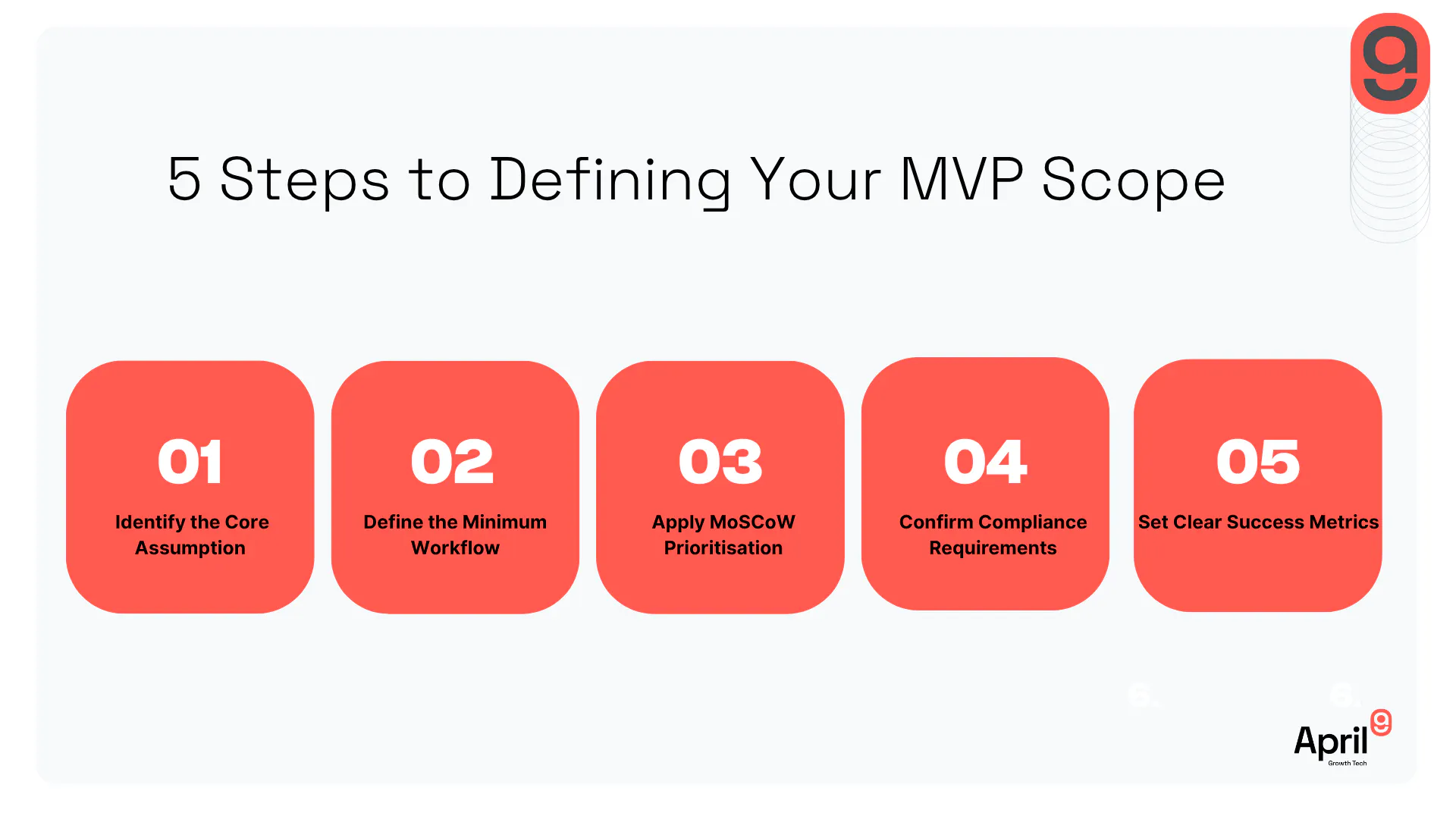
Defining an MVP scope is one of the most practically difficult exercises in software project planning. The instinct of most stakeholders is to include more rather than less, which produces an MVP that is indistinguishable from a full build. The discipline of genuine minimisation requires applying a strict filter to every proposed feature.
The right scope for an MVP is defined by answering one question: what is the single most important assumption this project rests on, and what is the minimum set of features required to test that assumption with real users?
Apply the following filters to every feature proposed for the MVP:
- Is this feature required to test the core assumption? If not, it belongs in phase two, not the MVP
- Can the core workflow function without this feature? If yes, it is a candidate for deferral
- Is this feature required for legal or compliance reasons at launch? If yes, it is a must-have regardless of minimisation pressure
- Would the absence of this feature prevent a real user from completing a real task? If yes, include it. If no, defer it
The software feature prioritisation framework, specifically the MoSCoW method, is directly applicable to MVP scoping. Must-have features for the MVP are those without which the core assumption cannot be tested. Everything else is a should-have or could-have for a subsequent release.
What Happens After the MVP
An MVP is not a finished product. It is a learning mechanism. The value of an MVP is not in what it delivers at launch but in what it reveals after launch. The feedback generated by real users interacting with a real system in real conditions is the primary input to the decisions that shape the full build.
After an MVP is launched, the organisation should expect to:
- Measure adoption and usage patterns. Which features are being used most frequently? Which are being ignored? Are users completing the core workflow as designed, or are they finding workarounds that indicate the workflow needs to change?
- Collect structured feedback. Qualitative feedback from users who have interacted with the real system is significantly more valuable than feedback collected during design. Users who have tried to accomplish real tasks with real data will identify gaps and friction points that no amount of pre-launch testing reveals
- Validate or revise the core assumption. The MVP was built to test a specific assumption. The post-launch evidence either validates that assumption or requires it to be revised. This is the decision point that determines what gets built next and in what order
- Prioritise phase two features. Using the usage data and feedback collected, reprioritise the backlog before committing to phase two development. The MVP evidence should drive phase two scope, not the original feature list
April9's Stack9 composable platform is specifically designed to support this iterative model. Because Stack9 is built from independently deployable components, features validated during the MVP phase can be extended and new features added in subsequent releases without disrupting what is already in production. Stack9 reuses 80% of code across projects and reduces development time by up to 50%, which means the cost of moving from MVP to full product is substantially lower than it would be with a fully bespoke architecture.
Related Reading: What to Expect During a Custom Software Project - A Timeline Breakdown
How April9 Approaches MVP Delivery
April9 works with Australian organisations to deliver MVPs with the same architectural rigour applied to full system builds. The minimum in MVP refers to scope, not quality, and an MVP built on a poor architecture creates the technical debt that makes the subsequent build more expensive than if the MVP had been built well from the start.
Every April9 custom software development engagement begins with a structured discovery and scoping phase that defines the core assumption the project rests on, the minimum feature set required to test it, and the architectural approach that will support the full build when the MVP is validated. This means the MVP is not a standalone exercise but the first phase of a coherent delivery programme, built on a foundation designed to grow.
For Australian organisations considering a custom software investment for the first time, the business case for custom software article provides a framework for evaluating whether a custom build, an MVP-led approach, or an alternative is the right starting point. April9 holds ISO 27001 certification since 2021 and brings over a decade of delivery experience across government, insurance, healthcare, and enterprise environments in Australia.
The Gallagher Bassett and Comcover FNOL platform was delivered within a year and achieved 30% faster claim submission and processing, a 45% reduction in time accessing applications, and zero security breaches since implementation. These outcomes were not the product of an MVP approach: the requirements were well understood, the workflow was defined, and full delivery was the right path. That distinction, knowing when an MVP adds value and when it does not, is what informed delivery experience produces.
For Australian organisations ready to evaluate whether an MVP is the right first step for their software project, get in touch to start the conversation.