The software development lifecycle, commonly referred to as the SDLC, is the structured process a development team follows to plan, build, test, and deliver a software system. Every custom software project follows some version of this process, whether the team has named it or not. Understanding what the SDLC is, what happens at each stage, and where the business stakeholder's role sits within it is one of the most practical things a non-technical leader can do before commissioning a software project.
Most cost overruns, delivery delays, and post-launch failures in software projects trace to problems that occurred at a specific stage of the SDLC and were not caught before they compounded. A business leader who understands the process can identify warning signs earlier, make better decisions at the points where their input is required, and hold development partners accountable more effectively throughout the engagement.
This article explains the SDLC in plain language for Australian business leaders, without technical jargon, and with a focus on the decisions and contributions the business needs to make at each stage.
Why Business Leaders Need to Understand the SDLC
The most common source of misalignment between business stakeholders and development teams is not technical complexity. It is the absence of a shared understanding of what the development process involves, when decisions are needed, and what the consequences of delayed or poor decisions are.
Business leaders who do not understand the SDLC tend to engage most actively at the beginning of a project, when requirements are gathered, and at the end, when the system is demonstrated before go-live. The stages in between, design, development, and testing, are treated as the development team's domain. This creates the conditions for the misalignments that surface in UAT as gaps between what was built and what was needed, because the business was not present during the stages where those gaps could have been caught.
A BCG survey found that up to 49% of organisations report nearly one in three software projects encounter significant delays. The Project Management Institute found that scope creep affects over 30% of enterprise software projects. Both problems are most effectively addressed by business leaders who understand the development process well enough to participate in it correctly, not just at the start and finish, but throughout.
The Six Stages of the Software Development Lifecycle
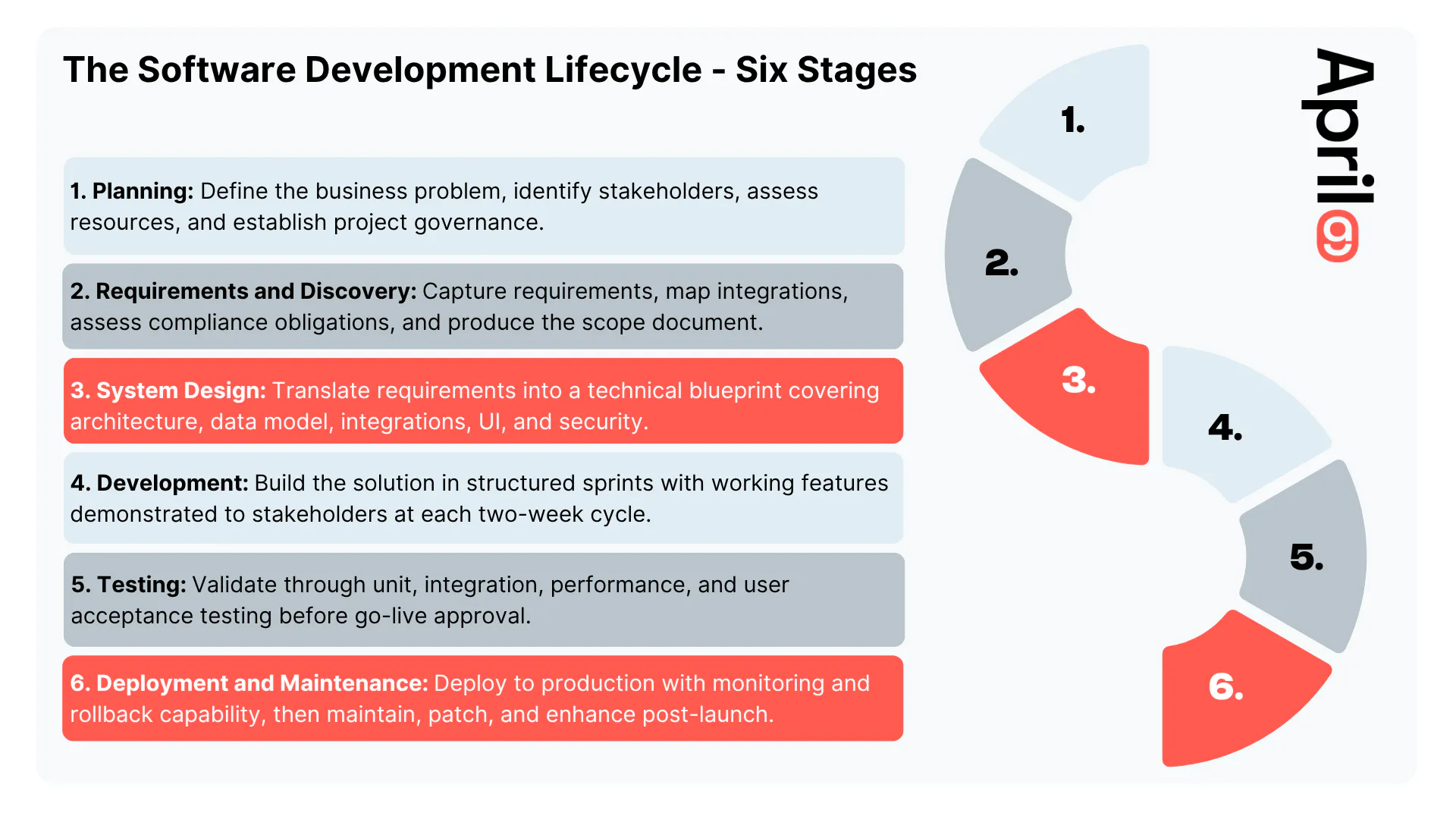
While different development methodologies use different terminology, the SDLC consistently covers six core stages. Each produces a defined output that becomes the input for the next.
Stage 1: Planning Planning establishes the foundation for everything that follows. It includes defining the business problem the software will solve, identifying the stakeholders whose requirements need to be captured, assessing the resources required to deliver the project, and establishing the governance structure that will manage it. A well-executed planning stage produces a project charter, a stakeholder map, a resource plan, and a risk register. These are not bureaucratic documents. They are the reference points that keep the project on track when decisions need to be made under pressure.
Stage 2: Requirements and Discovery This is the stage most business leaders are most familiar with: the requirements gathering workshops, the process mapping sessions, and the documentation of what the system needs to do. A thorough software discovery phase goes beyond requirements gathering to include integration mapping, compliance assessment, and architecture scoping. The output is a requirements specification and scope document that defines what will be built, what will not, and what assumptions the project rests on. The quality of this document is the single strongest predictor of whether the project delivers on time and on budget.
Stage 3: System Design Design translates the requirements specification into a technical blueprint. The system architecture, data model, integration design, user interface framework, and security architecture are all defined during this stage. Business stakeholders are involved in reviewing user interface designs and workflow prototypes to confirm they reflect operational reality. Changes requested at this stage cost far less to accommodate than the same changes requested during development.
Stage 4: Development Development is where the system is built. In an Agile methodology, development proceeds in two-week sprints, with working features demonstrated to business stakeholders at the end of each cycle. In a Waterfall methodology, development is completed before any business review occurs. The sprint review is the business stakeholder's primary touchpoint during development: the moment at which gaps between what is being built and what is needed can be identified and corrected before they are embedded across the system. Understanding how DevOps practices connect development and operations throughout this stage gives business leaders a clearer picture of how modern development teams maintain quality and speed simultaneously.
Stage 5: Testing Testing validates that the system works as designed before it is released to production. It covers multiple layers: unit testing by developers confirming individual components function correctly, integration testing confirming that connected systems communicate as expected, performance testing confirming the system operates reliably under load, and user acceptance testing confirming that the system meets business requirements as experienced by real users. UAT is the business stakeholder's formal validation that the system is ready for go-live.
Stage 6: Deployment and Maintenance Deployment moves the tested, approved system from the development environment to the live production environment. A structured deployment process includes pre-deployment verification, a defined cutover sequence, go-live monitoring, and a rollback plan in the event of a critical issue. Maintenance covers the ongoing activity of keeping the system operational, secure, and aligned with changing business requirements after go-live: patching, performance monitoring, compliance updates, and feature enhancements.
How the SDLC Differs Between Agile and Waterfall Projects
The six stages described above are present in every software project, but the way they are sequenced and executed differs significantly between Agile and Waterfall methodologies. Understanding this difference helps business leaders know what to expect from the engagement they are in.
In a Waterfall project, the stages are sequential and largely non-overlapping. Each stage is completed before the next begins. Requirements are locked before design starts. Design is completed before development begins. Testing occurs after development is complete. Business stakeholders see working software only at the end of the development stage, which may be months into the project. The advantage of this approach is predictability: the scope is defined early and the timeline is based on a known body of work. The risk is that misalignments between requirements and the built system are discovered late, when they are expensive to correct.
In an Agile project, the stages overlap and repeat in short cycles. Each sprint covers a miniature version of the full lifecycle: planning the sprint scope, designing the sprint features, building them, testing them, and demonstrating them to business stakeholders. Requirements evolve across sprints based on what is learned in each cycle. Business stakeholders see working software every two weeks rather than at the end of the project. The advantage is early feedback and lower cost of change. The requirement is active, consistent stakeholder engagement throughout the project.
For a detailed comparison of both approaches and guidance on which suits a specific project context, Agile vs Waterfall software development covers the decision framework in full.
Related Reading: What to Expect During a Custom Software Project - A Timeline Breakdown
Where Business Stakeholders Fit Into the SDLC
Every stage of the SDLC requires something from the business. The specific contribution varies by stage, but the common thread is that the quality of the business stakeholder's input directly affects the quality of the output at each stage.
The business stakeholder's role at each stage:
- Planning: Define the business problem clearly, identify the right stakeholders to involve, and establish the governance structure that will manage the project. Decisions deferred at this stage create ambiguity that compounds throughout the project
- Requirements and discovery: Be available and prepared for requirements workshops. Provide access to existing process documentation and system specifications. Make prioritisation decisions when trade-offs between features are required. Review and sign off on the scope document before it is handed to the development team
- System design: Review user interface designs and workflow prototypes. Confirm they reflect how the business actually operates. Raise concerns at this stage, not during development. Changes made during design cost a fraction of the same changes made during build
- Development: Attend sprint reviews. Review completed features promptly and provide specific feedback. Make decisions when the development team raises questions. Escalate scope change requests through the formal change management process rather than informally
- Testing: Participate actively in UAT. Allocate real user time for testing, not just IT staff. Log issues with sufficient detail. Make the go/no-go decision against agreed acceptance criteria
- Deployment and maintenance: Communicate the change to affected staff. Be available to support users during the post-launch period. Provide structured feedback that informs the enhancement backlog
The how to scope a software project guide covers the specific preparation business stakeholders need to complete before the SDLC begins to ensure every stage has the inputs it needs to produce the right outputs.

Free Guide
A Practical Guide to Custom Software Projects
Real pricing, transparent processes, and an honest look at what it takes to build software that lasts before you commit to your next project.
Download the Free GuideWhat Can Go Wrong at Each Stage and How to Prevent It
The failure modes in software development are well documented. Most of them are preventable by business leaders who understand the SDLC well enough to recognise the warning signs.
- Planning failures produce projects with unclear goals, undefined governance, and no shared understanding of what success looks like. Prevention: invest time in defining the problem precisely and establishing a governance structure before any development investment is committed
- Requirements failures produce systems built to the wrong specification. Prevention: invest in a formal discovery phase, apply the software feature prioritisation discipline before scope is locked, and ensure all relevant stakeholders have reviewed and signed off on the requirements document
- Design failures produce systems that are technically correct but operationally wrong. Prevention: review wireframes and prototypes actively and raise concerns before development begins
- Development failures produce systems where misalignments accumulate across sprints without being identified. Prevention: attend sprint reviews, review completed features promptly, and raise issues within the sprint cycle rather than deferring all feedback to UAT
- Testing failures produce systems that go live with known gaps. Prevention: resource UAT adequately, include real operational users, and resist go-live pressure when material issues are unresolved
- Deployment and maintenance failures produce go-lives that disrupt operations and systems that degrade over time. Prevention: plan deployment carefully with a rollback capability, communicate the change to affected staff, and invest in ongoing maintenance rather than treating go-live as the end of the project
For a broader view of why IT projects fail and the root causes that most consistently derail software engagements, the April9 analysis covers the structural patterns in detail.
Related Reading: How to Ensure Your Software Project Stays on Time and on Budget
How April9 Applies the SDLC in Practice
April9 applies a structured SDLC across every custom software development engagement, with business stakeholder involvement designed into each stage rather than treated as an optional contribution.
Every engagement begins with a formal discovery and scoping phase that produces the requirements specification, architecture design, integration map, and compliance assessment that make the subsequent stages reliable. Development proceeds in two-week Agile sprints with defined sprint reviews, transparent progress reporting, and a structured change management process for any requirements that arise during build. UAT is treated as a formal business-led validation phase with defined acceptance criteria, a structured issue log, and a documented go/no-go review before deployment proceeds.
The Stack9 composable platform makes each stage of the SDLC more efficient. Because Stack9 reuses 80% of code across projects from pre-built, independently deployable components, the design and development stages are substantially shorter than in a fully bespoke build. Stack9 reduces development time by up to 50% and cuts implementation costs by up to 40%. Pre-built components enter testing having already been validated in production environments, reducing the defect volume that surfaces during UAT.
April9 has held ISO 27001 certification since 2021, with over 110 monitored security controls covering the full development environment. Security and compliance requirements are addressed as design inputs from the discovery stage, not as post-build additions. The Gallagher Bassett and Comcover FNOL platform delivered 30% faster claim submission and processing, a 45% reduction in time accessing applications, and zero security breaches since implementation, outcomes produced by a disciplined SDLC applied consistently across every stage of the engagement.
For Australian organisations ready to commission a software project with a development partner who applies the SDLC with the rigour that reliable delivery requires, get in touch to start the conversation.